
ARTICLES
“To be truly radical is to make hope possible, rather than despair convincing.”
– Raymond Williams
Transforming our relationship ~with~ the future
Originally written as my contribution to the Jihlava Inspiration Forum book, October 2022
The following is my response to the invitation for a brief 1,000 word reflection on the topic:
“How should we transform our relationships for the future? And what can each of us do about it?”

“The crisis we face is fundamentally one of relating”
The more deeply I reflect on these words from the extraordinary Eve Annecke, the more truth they reveal.
And indeed, useful truth… of that special kind that opens real, practical paths for transforming our future. [i]
That said, I must be clear.
My own dark optimism does not permit me to convey the popular idea that our future can be “anything we dream”; nor even that it will be bright, at least in any common sense of the word. Quite to the contrary, our time is one of lessons long ignored coming back to bite.
Our time is one in which the common assumption that our children will be better off than us has already quietly reversed. One in which the hard consequences to hubris come starkly into view, even as we stubbornly insist that our destiny is off-world, exploring the stars…
So you may be sure I do not mean to imply that the coming years will be easy, or fair. But nonetheless, yes, even amidst these dark realities, it holds true that our ways of relating hold the key to transforming our future. I hear it everywhere.
The birds in my beloved forest tell me this, when I listen to their songs at dusk. Their cultures and kin have been decimated by ours yet, listen as I might, I hear no note of reproach in their music. Only a joyous outpouring at the miracle of being alive. If there is a message to humanity therein, it is only the ever-open hand, inviting us back to our birthright.
The greedy, ugly people tell me this, as I learn what it is to love them by not accepting their actions, by challenging them to be otherwise. By being more grateful for their potential than their reality, and relentlessly perceiving that in them.
The cells in my body tell me this, when they thrum with the excitement of a loving moment, an easy laugh or a wild dance, in spite of all that my mind knows of suffering and inevitability.
The past teaches me this, as the lessons we failed to learn return over and over. As the quiet taps of reality at our window strengthen and accumulate and threaten to blow out our doorframes.
As we shift our ways of relating to all these beings and more, we change our reality. The timbre of our days transforms, the focus of our hours shifts and the feeling of the whole world becomes different. At least to us.
After all, we see things not as they are, but as we are. And so if we want to change the world, we need not only change what we do, but how we see. Change what occupies and engages us.
This is the secret, I think, that Eve Annecke’s words gesture towards.
As the future we thought we were living into crumbles around us — and all things move towards their end, we may be sure — my late mentor David Fleming speaks from his own grave, [ii]
“We know what we need to do.
We need to build the sequel; to draw on inspiration which has lain dormant, like the seed beneath the snow.”
Daring souls like these point the way. We need not relate to the future with entitlement — and its brother, disillusionment — but can instead choose humility and joy.
We have the capacity to make this world — our lives, and those of all here with us — better than they would otherwise be. A chance to live lives of meaning and purpose, alongside others we love and respect, in defiance of all that is wrong around us.
What more have we ever had the right to ask of life?
So let us transform our relationship with the future that we are all too quickly living into, and in so doing transform our relationships with our human kin, with the more-than-human world, with our past, with ourselves.
What does this look like in practice?
Deliciously, it looks like everything we miss in the mainstream, oversaturated, overbusy, superficial world. It looks like all the things we naturally do when not otherwise compelled by economic necessity; it looks like music, play, family, time uncounted, activism, friendship, romance and home. It looks like learning to live cheaply so that we don’t have to sell our hours. It looks like giving those hours to our passions and friends. It looks like finding a far-deeper security in relationships than we will ever find in money. It looks like truly encountering the natural world, and hearing what she has to say. [iii]
Above all, it looks like refusing to accept the lie that the dominant culture is too strong, too powerful, to ever be reshaped. On the contrary, to my way of seeing it appears on its last legs, leaving it up to us to shape the sequels; to create radically alternative lives and cultures of fierce inspiration and joy.

Do you remember the time..? That time you encountered such a person or place..? The tentative opening of your heart to the notion that such magic might still be possible, in such a grey age. There it was — clear as day — somehow surviving or thriving in the cracks in the mainstream.
It’s time to widen those cracks by living inside them, by awakening others’ hearts into bravery, by claiming the power we each hold to reshape the future for ourselves and those around us. [iv]
That’s the path we’ve chosen, here at The Happy Pig, and through so doing have discovered that deep mix of grief and joy that living wholeheartedly through our time brings. [v] A tender mix that — just as the birds promised — can transform our relationship with everything.

[i] It seemed a passing comment at the time, during that winter’s online gathering for Surviving the Future: The Deeper Dive:
https://survivingthefuture.darkoptimism.org
Since then I have also read Eve Annecke’s weird and wondrous piece Living in a River, delving deeper, https://www.earthed.world/living-in-a-river
[ii] David Fleming, from the introduction to Lean Logic: A Dictionary for the Future and How to Survive It, available at:
https://leanlogic.online/introduction-david-fleming/
[iii] For inspiration, see:
https://leanlogic.online/encounter/
[iv] Shaun Chamberlin, Dark Optimism, “Humanity, not just a virus with shoes”,
https://www.darkoptimism.org/2019/08/06/humanity-not-just-a-virus-with-shoes/
[v] For more about the author’s home at The Happy Pig in Ireland, see:
https://mstdn.social/@DarkOptimism/109410285273214948
A Dictionary for Our Times
Originally published in the Spring 2020 edition of STIR magazine
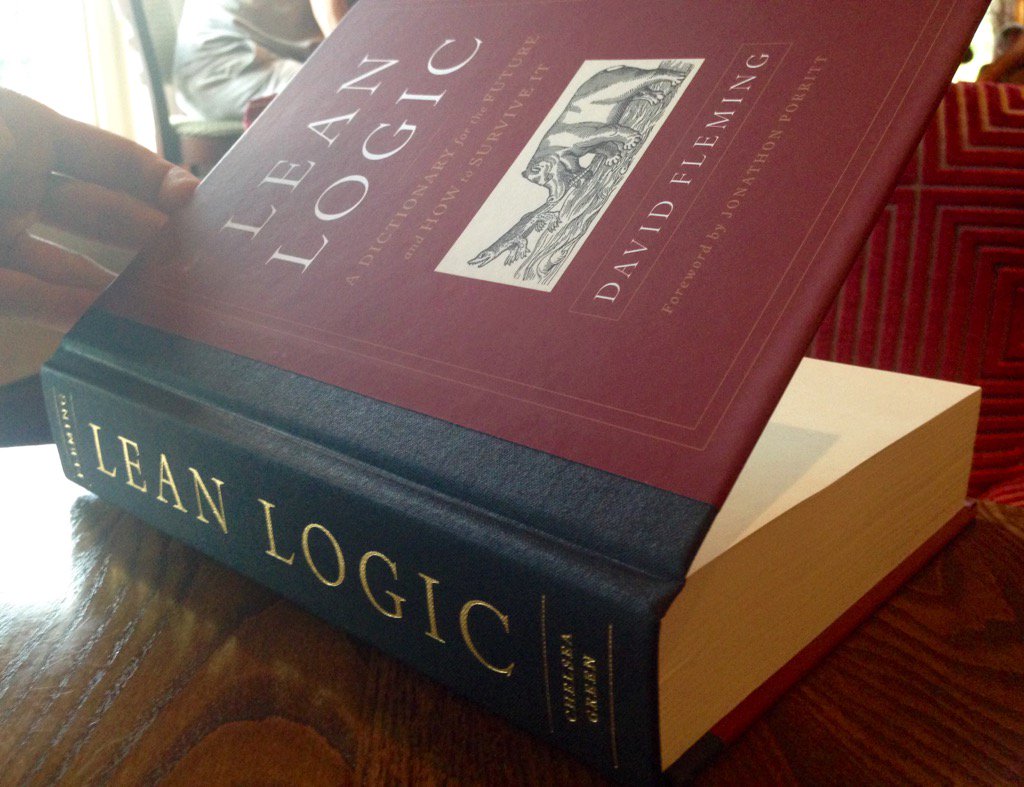
Extracts from David Fleming’s extraordinary, posthumous Lean Logic: A Dictionary for the Future and How to Survive It (Chelsea Green, 2016). Selected for this issue by its editor Shaun Chamberlin. Endnotes omitted.
Asterisks mark words with their own separate entry in the dictionary. Any of these can be read in full and for free at the newly-launched LeanLogic.online
Expectations. The attitudes and assumptions which shape the way we make sense of events and plan our response. Unless our expectations are right, or at least expressed as a considered set of probabilities, we plan to fail. But, right or wrong, expectations are self-reinforcing, for we see what we expect to see. We may not realise how critical expectations are in guiding perception, but they are decisive. In the context of our perception of *art, the art historian E.H. Gombrich reminds us of . . .
. . . the role which our own expectations play in the deciphering of the artists’ cryptograms. We come to their works with our receivers already attuned. We expect to be presented with a certain notation, a certain sign situation, and make ready to cope with it.
 The experience of the approaching civilisational convergence of crises will affect our expectations in three ways. First, options which were formerly dismissed will now be grasped with both hands, and we may wonder how we could have been so stupid as to turn them down when they were still available. Secondly, opinions and fundamental values, hitherto seen to be sacrosanct and *self-evident, will be challenged and may break down rapidly. Thirdly, there is likely to be expectations-creep, as the (bad) new conditions are seen to be as acceptable as the (good) old ones used to be, without people being explicitly conscious of having changed their opinion. Events will change the frame of reference in which we make *judgments.
And there may be a *time-lag, leaving us always one step behind, fighting the last war, although *lean thinking—for which fast *feedback is a core principle—would help us keep this lag brief. Critical to this is a sense of history. History forms our expectations; it is our data. Without a sense of history, our expectations are the product of how we live now.

Cohesion. Society’s ability to hold itself together over a long period, despite stresses which would otherwise break it apart. The *market economy is an effective system for sustaining social order: the distribution of goods, services and other assets is facilitated by buying and selling, supporting a *network of exchange to which everyone has *access. But if the flow of income fails, the powerfully-bonding combination of *money and self-interest will no longer be available on its present all-embracing scale, and perhaps not at all.
It will then be necessary to rely instead on the cohesive properties of a robust common *culture, and the *loyalties and *reciprocities supported and sustained within it. Without this, there will be no basis for a cohesive society. And that, of course, is putting it mildly, because the time-interval between the demise of the market and the birth of a cohesive culture may be expected to be turbulent.
Reliance on the market economy has led to the asset of a common culture falling into neglect; sometimes we pick through the ruins like tourists marvelling at a lost settlement and guessing at what was once there. It would be helpful—though late in the day—to stop dismantling what remains of a culture in today’s *political economy, and to start to re-grow cultural and *artistic links as an essential basis for cohesion in a future which, from where we sit, will be barely recognisable.
Empowerment. Empowerment, applied to the individual or the *community, means being confident, being assured; having the *authority to think things through and to act accordingly. In contrast, disempowerment speaks of apathy, futility, lack of hope and lack of influence over one’s own destiny. The disempowered person, population or class is one that no one listens to—the electorate that is patronised and reduced to an *abstraction of consumers, not to be entrusted with doing anything for themselves unless they see a *private advantage. It is about accepting passively what comes along, because there is *no alternative. Empowerment, in contrast, dances to a different logic: it is about investing *imagination and energy in the *place we live in, and in the people we live amongst.
In fact, Lean Logic prefers the label *presence: it suggests permanence and natural competence, without the rather breathless sense of self-assertiveness and ‘recovery as work-in-progress’ that we get with empowerment. Indeed, as the management writer Daniel Pink points out, empowerment is an awkward word—almost an oxymoron—since it suggests that some kind authority is giving you lots of empowering flexibility—like a dog on a long lead—which is far from the autonomy of being able to choose your own route and apply your own mind:
[Empowerment] presumes that the organization has the power and benevolently ladles some of it into the waiting bowls of grateful employees. But that’s not autonomy. That’s just a slightly more civilized form of control.
But “empowerment” may communicate more clearly than “autonomy”—and the process of recovering, or wresting, or even being donated with, powers and freedoms that we didn’t have before is in fact what is typically and urgently needed—so, with Pink’s caveat in mind, we shall stay with it, for now.
The civilisation which we have *inherited is a product of empowerment, widely-shared. In the medieval period it built *institutions of great competence. The monasteries, for example, acted as schools, hospitals, centres of the arts, history, science and horticulture; they provided assistance for the poor, old peoples’ homes, safehouses and prisons; and they were effective instruments for the control of *population. The manorial system of *land tenure and cultivation—though contained within a strong and at times harsh framework—was kept functioning by the people who belonged to it, sustaining *cooperative *commons as a central enabling institution for some four centuries. The *law, to an increasing degree, arose out of deliberation by the “republic”—the community of citizens with responsibility for the place they lived in, and it was sustained, not least, by local people as juries and magistrates.
 Through that period and beyond, local competence sustained *carnival, music, architecture, and the *reciprocities of *social capital; it supported *households, delivering the routine miracle of making people, teaching language, building *emotional development, *humour, handiness, and the accomplishment of listening and friendship. And its achievements continued into the modern period through the Industrial Revolution. It built the institutions—the schools, hospitals, local government and (later) friendly societies which, though voluntarily taken up, provided widely-shared *protection against loss of income through sickness and unemployment. It developed to keep pace as the social order broke beyond the limits that could be sustained by local self-reliance and needed to be invented and rebuilt on the scale of the city-everywhere.
In a sense, the roots of disempowerment that followed can be traced a long way back, to the invention of *money by the Greeks—the turning point at which the integration between skills and community began to fracture. Informal *reciprocal exchange began its long descent towards being a residual—merely the parts that monetary *economics hadn’t yet reached. In our nearer history, early signs of what was to come began with the dissolution of the monasteries, the Enclosures—the loss of common land—and by the progressive retreat of domestic competence and local reciprocity, as money exchange—detached, impersonal, efficient, neat—tore through the *informal economy, which had no immunity. And now, *economism has brought the presumption that all values are economic values, and a demolition of confidence that there is any such thing as society, a thing which we can love (*Public Sphere and Private Sphere).
The power of economism has been formidable. The progressive removal of hands-on responsibility for the community has been carried through almost without challenge. And here are the losses: our sense of *place and the idea that it is in our power to care for it and to take responsibility for it; our regard for and accomplishment in *manual skills; our confidence that we have anything to teach, and can cope without massive institutions behind us; that combination of originality and persistence known as *character; a *culture committed to the making and sustaining of emotional development; our land as a rich, living *ecology, protected (unconditionally) from *genetic modification and *nuclear contamination and (substantially) from concrete; our *manners and our sense of the wild (which, in deep ways, are the same things); our *spirit; our consciences and, perhaps, our future.
The balance sheet we have inherited is a wasteland. And yet, buried under economism and its anticulture, a seed growing secretly, is a human ecology. That is what—in the early stages of working out what empowerment means—we may with persistence, recover.
Frankness. The exposure of ideas and opinions, formerly forbidden by the *ethics and values of society, which can be expected to erupt in the disorderly conditions that will follow the *climacteric. Under the surface in the well-behaved citizen, there is a *second nature, to whom outrageous thoughts and opinions occur, but which the person has no trouble in censoring and keeping in check. In deeply destabilised conditions, however, that second nature tends to break out; the *decency-censor is ignored; the person’s second nature becomes, simply, her nature.
The shock of a new frankness has been experienced before—for example, at the time of the Renaissance, when changing *expectations were forced into even more violent change by recurring outbreaks of the plague. Giovanni Boccaccio’s Decameron explores this disorder with astonishment. The *conversations described in it (he explains) do not take place in church, nor in schools of philosophy, but in the whorehouse. In fact, the times are so out of joint that . . .
. . . judges have deserted the judgment-seat, the laws are silent, and ample license to preserve his life as best he may is accorded to each and all. . . . If so one might save one’s life, the most sedate might without disgrace walk abroad wearing his breeches on his head.
Fortitude. Persistence in the face of trouble, danger, *conflict, mockery, fatigue, solitude, *demoralisation, guilt or *fear. It can be mere bloody-mindedness, of course; it is the connection with *judgment that matters. And yet, the judgment itself may be *intuitive. Bloody-mindedness can save the day.
Wood engravings from Lean Logic:
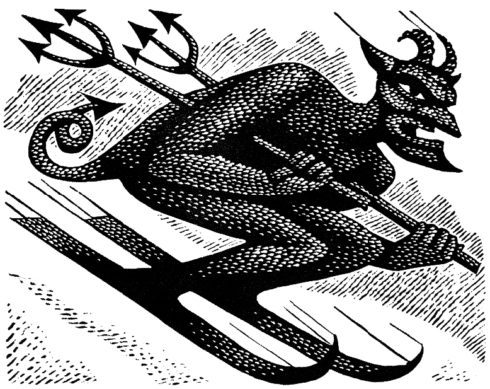
‘The Slippery Slope’ by Harry Brockway, and ‘Cottage Interior’ by Howard Phipps.
Shaun Chamberlin is a consulting scholar at Sterling College and executive producer of new film The Sequel: What Will Follow Our Troubled Civilisation?
The Sequel: Life After Economic Growth
Originally published in the Fall 2018 edition of Tikkun

As Simon Mont wrote in Tikkun’s recent issue on the New Economy, “capitalism is collapsing under the weight of itself, and it’s not pretty.”[i]
Our globalised world finds itself caught on the horns of a seemingly impossible dilemma — either cease growing, and so collapse the economy on which we all depend, or continue to grow until we overwhelm and destroy the ecosystems on which we all depend.
As my late mentor, the historian and economist David Fleming, put it,[ii]
It is certain that there are no simple answers to this — none that could be proposed without proposing at the same time a transformation in the whole of the way we think, work and order our lives.
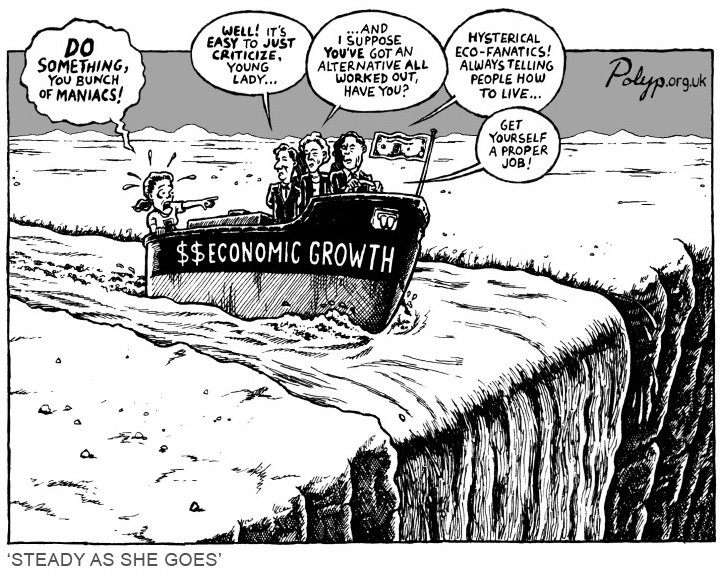
And yet, faced with this fundamental systemic conundrum, our leaders hold tight to their simple answer — growth. Having worked supporting people with drug addiction for several years, it is hard to escape the parallels to the more tragic cases. The dire consequences of our choices are piling ever higher around us, threatening the very continuation of our lives and those around us. And the response is to double down on the current path and turn a blind eye — to sink deeper into denial. It is just too difficult, too brave, to undergo that dark night of the soul — to admit the problem, to seek a new paradigm.
So we hear it over and over — we must keep growth high, keep unemployment low. Donald Trump’s recent Twitter boast that U.S. GDP growth (4.2%) was higher than unemployment (3.9%) for the first time in over a century was both inaccurate and bizarre, but it betrays his allegiance to these numbers.
And of course, he is far from alone. All his peers are junkies too. Most people — even most economists — never question the desirability of these measures, as if mastery of them could somehow heal an economy so violently contrary to our human instincts and desires that it leaves epidemics of depression, loneliness and suicide everywhere it goes. That sparks not only economic and environmental devastation, but cultural and spiritual annihilation.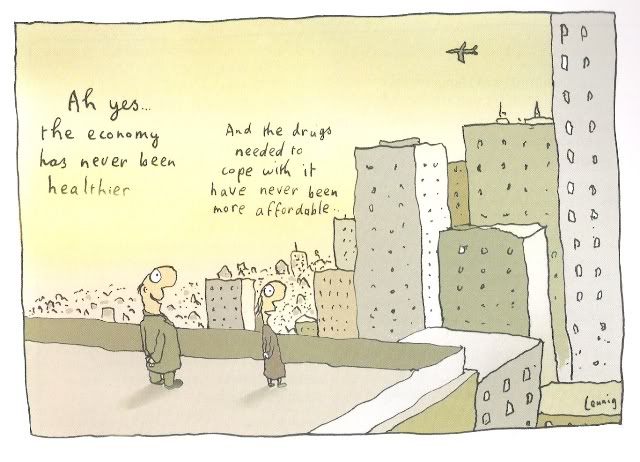
As if there were not something deeper, something larger, going on here…
So let’s step back for a minute. First, “keep unemployment low”. The appeal is easy to see, but what’s really going on here?
Consider the great economist John Maynard Keynes’ prediction, in 1930, that by the year 2000 the onward march of technology would lead to an average 15 hour working week in countries like the U.S. and U.K. Naturally he saw this as progress — not a doom-laden prophecy of mass unemployment — and this fact begins to expose the inherent contradiction in the aim of maximising employment. What economists see as wastefully underutilised ‘spare labour’ is what most of us might call spare time — time enjoyed outside the formal economy — a welcome part of a life well lived rather than a ‘problem of unemployment.’[iii]
Of course, modern life is not noted for the utopian, leisurely daily routines enjoyed by the bulk of the population. So why was Keynes wrong? Certainly not because the rate of technological advance over the past century failed to live up to his expectations. No, rather because our economic paradigm literally makes widely-shared leisure time impossible.
To see why, Fleming invites us to take a further step back. He notes the startlingly extensive holidays (five months of each year, in some places) achieved in medieval Europe. How were the good folk of the Middle Ages able to enjoy so much more leisure time than we are in our technologically-advanced society? He explains,[iv]
In a competitive market economy a large amount of roughly equally-shared leisure time — say, a three-day working week, or less — is hard to sustain, because anyone who decides to instead work a full week can produce for a lower price (working longer hours lets them produce more, and thus earn the same wage while selling each item or service more cheaply).
These more competitive people would then be fully employed, and would put the more leisurely out of business completely.
This is what puts the grim into reality.
So in an economy like ours, a technological advance that doubles the amount of useful work a person can do in a day becomes a problem rather than a benefit. It tends to put half the workers out of work, turning them into a potential drain on the state (or simply leaving them destitute).
In theory all the workers could just work half-time and still produce all that is needed, as Keynes predicted, and as is promised all over again by today’s latest wave of automation techno-utopians.[v] But in practice workers are often afraid of having their pay cut, or losing their jobs to a stranger who is willing to work longer hours. In the absence of a sense of community or mutual trust, and having been taught to seek their security in a wage, people instead compete against each other for the right to perform the pointless tasks that anthropologist David Graeber memorably characterised as “bullshit jobs.”[vi]
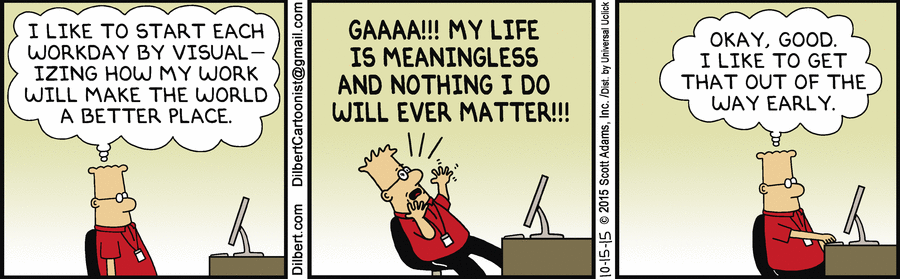
Meanwhile, governments see that the only way to keep unemployment from rising to the point where the system breaks down is through endless economic growth, which thus becomes a non-negotiable obligation — a dogma. Ah, here’s our second simple imperative, “keep growth high”…
The problem with this one is elementary, brutal maths. Economists tell us that 2-3% growth annually, give or take, is necessary to avoid recession or depression. Arithmetic tells us that if something grows at 2% a year, it will double in size in 35 years. At 3% a year it will double in 24 years. At Trump’s claimed 4.2%..? 17 years
Can we seriously imagine our world in just two or three decades with twice the economic activity — twice the oil extraction, twice the intensive agriculture, twice the manufacturing, twice the pollution? And then in two or three more decades doubling again, to four times the size of today’s economy… Even superabundance like that of the natural world cannot indefinitely support an exponentially growing parasite.[vii]
It’s a remarkably straightforward point; just arithmetic. And yet it remains respected mainstream opinion that we should just keep growing, quietly crossing our fingers that somehow Nature — the economy upon which all others depend — will defy both physics and maths and continue to bail us out forever. As Fleming put it,[viii]
Civilisations self-destruct anyway, but it is reasonable to ask whether they have done so before with such enthusiasm, in obedience to such an acutely absurd superstition, while claiming with such insistence that they were beyond being seduced by the irrational promises of religion.
In this context, then, it’s no surprise to be hearing increasingly shrill, desperate alarm from scientists around the world as they observe the natural world crumbling under the impossible, ever-growing pressure. As I write, the latest report announced that 60% of mammals, birds, fish and reptiles have been annihilated since 1970. Put starkly, most of the wild nature that was here fifty years ago is gone. And still we seek to grow the human economy, and cheer when that growth accelerates.[ix]
Similarly, the inherently conservative Intergovernmental Panel on Climate Change released their Global Warming of 1.5ºC report, which makes it abundantly clear that the unfolding physical realities studied by climate science are dramatically outpacing the policies notionally intended to address them. They find that we must halve emissions in the next twelve years, and so feel forced to call for “rapid and far-reaching … unprecedented” transformation in the economy.[x]
Hence it has become impossible to be simultaneously realistic about both the political climate and the science of climate. The two stubbornly refuse to reconcile, so we are forced to decide which carries more weight, and then be profoundly unrealistic about the other.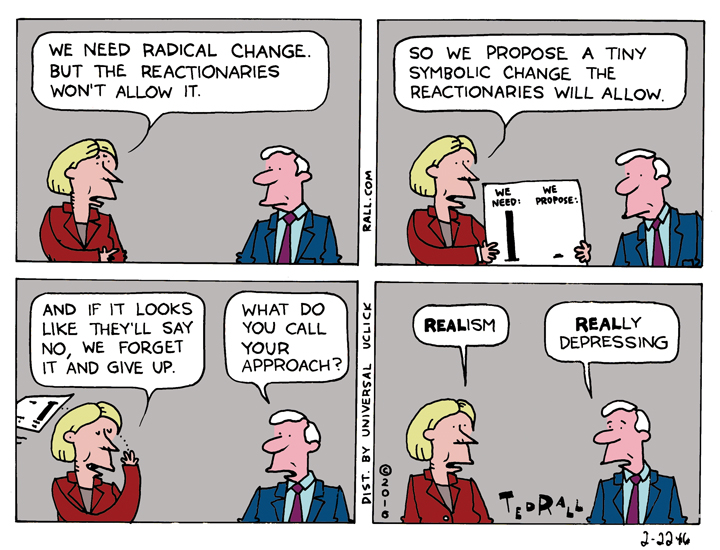
To take present policy seriously demands a total rejection of the science. To take the science seriously demands a total rejection of the policy on the table. And so grassroots movements like the Extinction Rebellion and Climate Mobilization are emerging — the realists of a larger reality.
They recognise that the dominant politico-economic paradigm leads to nothing but a literal dead end. We are on the cusp of a fundamental shift, for better or worse — either we change direction or we end up where we are headed.
It’s interesting then that a change of direction is exactly what electorates have been voting for, or at least trying to. Globalisation and neoliberalism are not only destroying our collective future, but have also all-but-destroyed the present for many, as the neofeudalism termed ‘austerity’ continues to bite. The common factor behind unexpected election results like Trump in the US, Brexit and Corbyn in the UK and Bolsonaro in Brazil appears to be desperate rejection of the establishment and the status quo.
Unfortunately, in such times, when more and more people are struggling to support their families, and losing faith in the dominant stories of what is important, the far right has a track record of providing simple answers. It is important to remember that fascists like Mussolini and Hitler didn’t only consolidate power on the basis of lies and fear — they also raised wages, addressed unemployment and improved working conditions.
To effectively challenge the drift into fascism, then, we need to present an alternative politico-economic vision that can restore identity, pride and economic well-being. We need to tell a beautiful story of how we will make the future better for the desperate, rather than a fearful one. To provide a grounded, compelling alternative to a future I have no desire to live through.
This is what Fleming devoted his life to developing. Fifty years ago he saw the central dilemma of our times approaching, and devoted his life to facing the inevitable question — what might a life-sustaining, nourishing economy look like, after the impending end of economic growth.
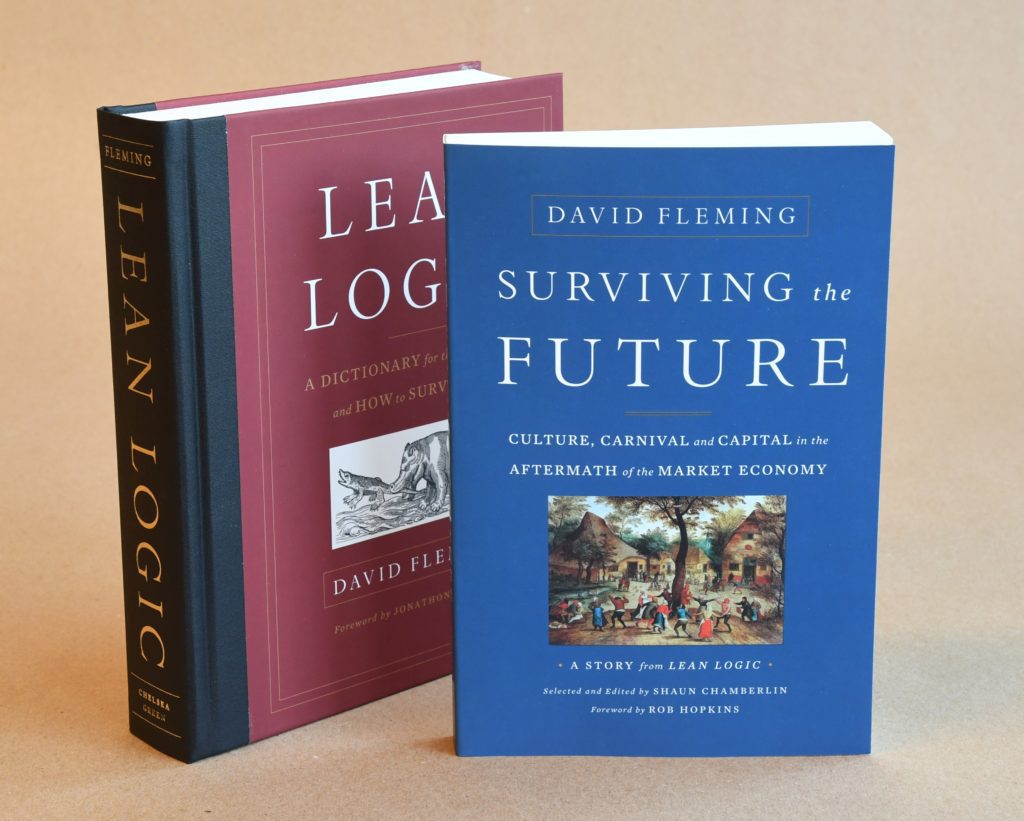
This culminated in his posthumous 2016 book Surviving the Future: Culture, Carnival and Capital in the Aftermath of the Market Economy.
Therein, he reminds us of just how unusual today’s ‘ordinary’ is, and how profoundly unrealistic it is to pin our hopes on market capitalism — an economic system that has existed for less than 1% of recorded history and is already not only destroying its own foundations, but those of life on Earth. In his words,[xi]
The Great Transformation has already happened.
It was the revolution in politics, economics and society that came with the market economy, and which hit its stride in Britain in the late eighteenth century.
Most of human history had been bred, fed and watered by another sort of economy, but the market has replaced, as far as possible, the social capital of reciprocal obligation, loyalties, authority structures, culture and traditions with exchange, price and the impersonal principles of economics.
This historical context is critical. The New Economy that we need is, in many ways, the Old Economy.
It is time to rediscover the ways human beings related to each other for hundreds of thousands of years before we were ripped into isolation by the brief historical anomaly of market capitalism, into which all of us alive today happened to be born.
As Mont put it,[xii]
[The New Economy] is a groundswell to relying on a memory harbored in our hearts to make real a vision of humans returning to deep relationships with earth, spirit, and each other, that is constantly evolving and changing, while staying acutely cognizant of the fact that we must relearn how to keep ourselves alive without capitalism and extraction.
Fleming took that dear memory harbored in our hearts and wrote it large across the page. “We know what we need to do,” he writes, “We need to build the sequel, to draw on inspiration which has lain dormant, like the seed beneath the snow.”
His sparkling, tantalising writing has become a touch-stone for thousands of communities around the world who are putting it into practice, with his startling seven-point protocol for an economics based in trust, loyalty and local diversity one of the key factors in the birth of the now-global Transition Towns movement.
Drawing on the work of the likes of Edgar Cahn, Fleming provides the radical but historically-proven sequel to today’s capitalism: focusing neither on the growth nor de-growth of the market economy, but on huge expansion of the ‘informal’ or non-monetary economy — the ‘core economy’ that keeps our society alive, even today. This is the economy of what we love: of the things we naturally do when not otherwise compelled, of music, play, family, volunteering, activism, friendship and home.
Refreshingly — uniquely perhaps, among modern economists — he argues that the key to sustaining a post-growth economy is culture and community. Those extensive holidays of former times were far from a product of laziness. Rather they were, in an important sense, what men and women lived for. ‘Spare time’ spent in feasting, performing, collaborating and merrymaking together formed the basis of communal bonding, membership and trust. As one of his readers put it — when productivity improves, “in our system you have a problem; in Fleming’s system you have a party”.

These shared cultural ties then bind people together in cooperation, support and solidarity, the essential foundations for the communities which have thrived throughout history in the absence of economic growth or full-time employment. As Fleming writes,[xiii]
The [future] economy will depend for its existence on a deep foundation in culture.
It is possible to live without it, but only for a time, like holding your breath under water.
This is a key lesson for our organising and our community work. With its rare blend of charm and rigour, Fleming’s writing reminds us that nurturing the core economy back to health — getting to know people, enjoying time together and helping to provide for each other’s basic needs — is not merely some quaint and obsolete shared longing, but an absolute practical priority.
Over the past couple of centuries, this core economy has been much weakened, as the ever-growing stresses of precarious employment and rising prices have left people with less time and energy for friends, family and fun. But as we in communities around the world spend our days relearning how to seek our security in each other rather than in money, we notice that the unfolding collapse of the omnicidal growth economy becomes less something to fear, and more something to celebrate.
We think less about what we might stand to lose and far more about the joys we had already lost and are slowly learning to regain, together. At long last we are remembering how to build a world in which, as David put it, “there will be time for music.”
__
Shaun Chamberlin authored the Transition movement’s second book, The Transition Timeline, and has served as both chair of the Ecological Land Co-operative and a director of Global Justice Now. He is the executive producer of 2020 film The Sequel: What Will Follow Our Troubled Civilisation? and editor of several books, including David Fleming’s posthumous Lean Logic and Surviving the Future.
[i] Mont, S. (2018). Introduction to the next economy. Tikkun, Volume 33, Number 3:16-17.
[ii] Fleming, D. (2016). Surviving the Future: Culture, Carnival and Capital in the Aftermath of the Market Economy (p. 129). White River Junction, VT: Chelsea Green Publishing.
[iii] Keynes, J. M. (1930). Economic Possibilities for our Grandchildren. Available at: http://www.econ.yale.edu/smith/econ116a/keynes1.pdf
[iv] Fleming, D. (2016). Surviving the Future: Culture, Carnival and Capital in the Aftermath of the Market Economy (p. 75). White River Junction, VT: Chelsea Green Publishing.
[v] These claims have a long history. The Democratic Review, impressed by the new technologies, predicted in 1853 that by 1900, “men and women will then have no harassing cares or laborious duties to fulfil. Machinery will perform all work — automata will direct them. The only task of the human race will be to make love, study and be happy”.
[vi] Graeber, D. (2013). On the Phenomenon of Bullshit Jobs: A Work Rant. STRIKE!, Issue 3. Available at: http://strikemag.org/bullshit-jobs
[vii] In the words of Prof. Albert Bartlett, “The greatest shortcoming of the human race is our inability to understand the exponential function.” His legendary ‘Arithmetic, Population and Energy’ lecture is one of the most important ever recorded and widely available online, e.g. at: https://www.albartlett.org/presentations/arithmetic_population_energy.html
[viii] Fleming, D. (2016). Surviving the Future: Culture, Carnival and Capital in the Aftermath of the Market Economy (p. 180). White River Junction, VT: Chelsea Green Publishing.
[ix] WWF (2018). Living Planet Report – 2018: Aiming Higher. Grooten, M. and Almond, R.E.A. (Eds). Gland, Switzerland.
[x] IPCC (2018). Global Warming of 1.5ºC, Summary for Policymakers (p.21). Available at: http://report.ipcc.ch/sr15/pdf/sr15_spm_final.pdf
[xi] Fleming, D. (2016). Surviving the Future: Culture, Carnival and Capital in the Aftermath of the Market Economy (p. 179). White River Junction, VT: Chelsea Green Publishing.
[xii] Mont, S. (2018). Introduction to the next economy. Tikkun, Volume 33, Number 3:16-17.
[xiii] Fleming, D. (2016). Surviving the Future: Culture, Carnival and Capital in the Aftermath of the Market Economy (p. 40). White River Junction, VT: Chelsea Green Publishing.
Confessions of a Hypocrite: Utopia in the Age of Ecocide
Originally published in the Fall/Winter 2016 edition of the Kosmos journal

I confess — I love Magnum ice creams!
Yet surely as a good, responsible eco-citizen, I must be aware that these relatively cheap, beautifully packaged nuggets of deliciousness are inescapably products of the industrial system that is destroying all that I hold dear?
That Magnums are produced by Unilever, not only the world’s biggest ice cream manufacturer but the world’s third largest multinational consumer goods company, associated with deforestation for palm oil, exploitation of workers, the promotion of unsustainable agriculture, factory farming, the use of tax havens, lobbying against GM labelling and so on…
I don’t mean to imply that they’re the worst offenders. It’s just that I happen to particularly enjoy their product (despite being aware that there’s no actual cream in it). For me, it’s what Unilever’s marketing team would doubtless term a ‘wicked indulgence.’
So I should stop eating them, right? I should overcome my baser urges and live a lifestyle that accords with my values and beliefs?
Well, there is certainly an argument for that, and I know many friends who struggle and expend huge energy and willpower on resisting their deep desire for Magnums, or bacon, or jet flights or whatever… And even feel resentment towards those who don’t do the same.
Occasionally, of course, they give in and then feel huge guilt, and maybe greater ill will towards those who seem to consume without even feeling this inner conflict.
With this approach, it is little wonder that we environmentalists are often characterised as tedious killjoys who wouldn’t know how to enjoy ourselves in a vegan chocolate factory. Perhaps it is even fair. After all, there is nothing inspiring about the struggles of a divided and conflicted self. And there is nothing less inspiring than ‘shoulds.’ With the possible exception of ‘should nots’…

But what is the alternative, if we are mindful of the consequences of our actions? How can we live lives of full joy, without sacrifice, guilt or wilful ignorance? For me, what works is letting the two sides of my self talk to each other. The part that desires the Magnum and the part that does not desire the consequences. Rather than choosing between them, I let them talk it out. Surprisingly, perhaps, they seem to come to an agreement quickly enough.
So most of the time, I choose not to eat Magnums for the simple reason that I could not do so with my whole heart. Part of me would indeed feel sad for the consequences I see to my actions, and while I might be able to shut down that part of myself — to quiet the voice of that awareness in me — in doing so I lose much of the joy of the experience. And if only part of me could enjoy that meal, I would be bringing about those negative consequences without even fully appreciating the pleasures. To play a part in the death of the world for the sake of filling an empty, joyless hole is surely the saddest of fates.
But, just occasionally, I do eat them, and I do so wholeheartedly, taking full delight and hedonistic pleasure in the sensory extravaganza. Not because I have successfully quelled or overcome my morals, but because I have integrated them.
Maybe on that day I am tired or heartbroken from a defeat. Perhaps all parts of me know that the simple pleasures of the indulgence will help revive my spirits and reinvigorate my soul and my work for a more beautiful world. Nothing wrong in that. But before making the purchase, I will ask myself a simple, honest question: Would those exploited workers, those ruined ecosystems, begrudge me this pleasure?
With over 10,000 Magnums sold every hour in Britain, one may not make much difference, and perhaps the boost it gives me counts for more than the damage done. On the whole, it is thoughtless habitual purchases that make up the bulk of the problem, not mindful one-offs. Most of the time, I prefer to find sustenance in other things but once in a while I find that my best understanding of those victims hears them saying “go on, just one!”
And then I enjoy the pleasure deeply and thoroughly and without a hint of guilt, while using it to remind myself of my commitment to working for change. As I understand Native American nations have it, in eating something, you take on a responsibility for the wellbeing of the people and systems involved in producing it.
And, in truth, over the long term, I find that I desire such indulgences less and less often. Without any conflict, moralising, denial or shoulds.
Yet what if someone tells me that Magnums are even more damaging than I realised, that my occasional pleasures are contributing to still greater evils than those I listed above?
Happily, I find that having banished shame, such new information becomes entirely welcome — it can only help me shape a life that is more in tune with my deepest desires. Hopefully, one day I will find similar pleasure in refreshments that support the world I wish to inhabit.
But hold on. I wholeheartedly enjoy the fruits of the system while working to change it? I eat Magnums, yet if I could eliminate the system that produces them I would do so in a heartbeat? Doesn’t this make me a shocking hypocrite?
Well, when faced with accusations of hypocrisy, I turn to my dear late mentor David Fleming’s just-published masterpiece Lean Logic,1
If an argument is a good one, dissonant deeds do nothing to contradict it.
In fact, the hypocrite may have something to be said for him… There is no reason why he should not argue for standards better than he manages to achieve in his own life.
Indeed, it would be worrying if his ideals were not better than the way he lives.
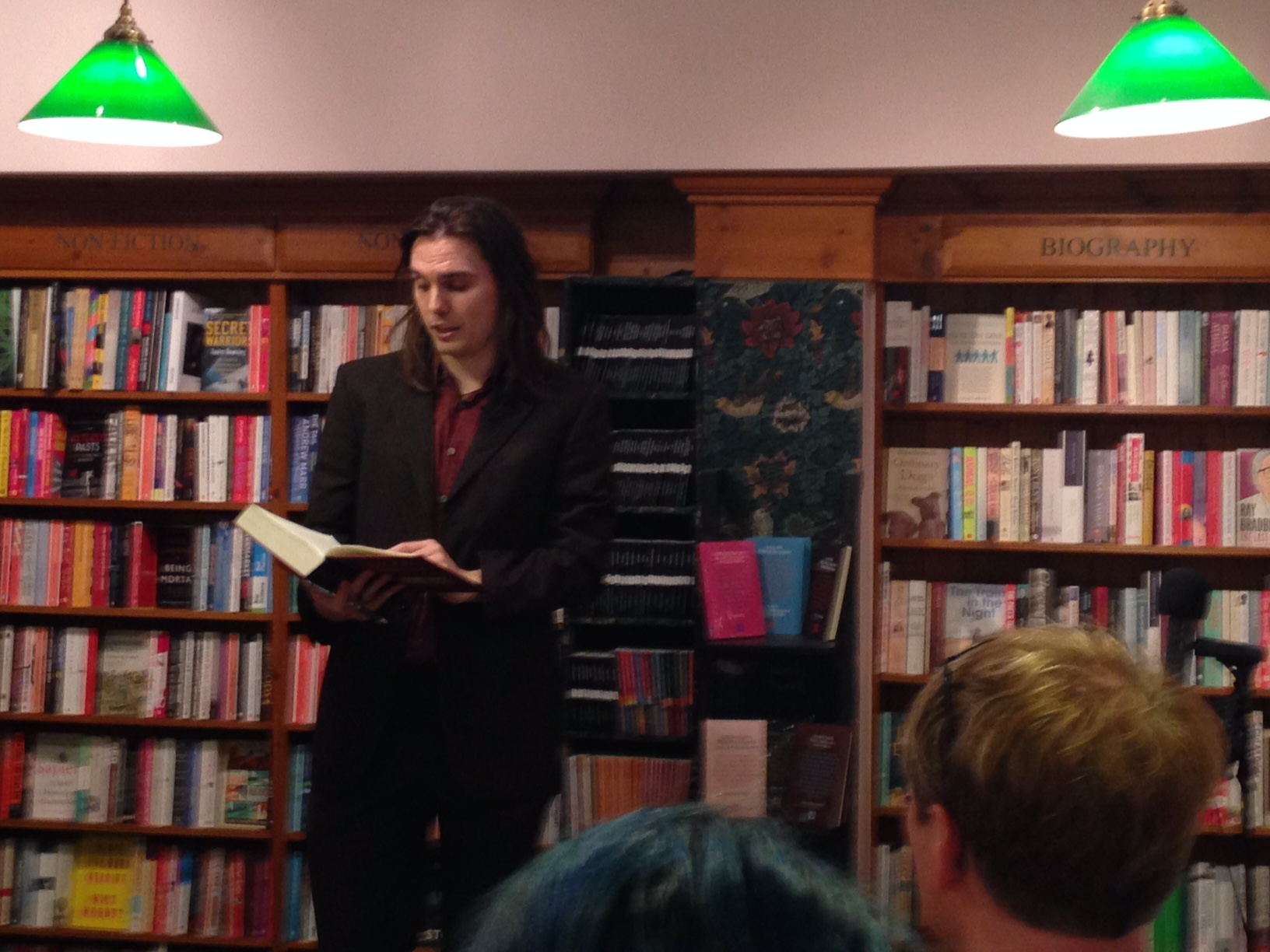
Shaun reads from Lean Logic at the book’s launch event in London, September 21, 2016
Most of us were born into an ecocidal culture. And when advocating that the culture we came from and depend upon changes its ways, accusations of hypocrisy often follow. Yet if our response to this is to withdraw from the discussion until we have “set our own house in order” and developed a perfect lifestyle, we will disappear from the conversation altogether, taking the ideals we believe in along with us.
In truth, accusations of hypocrisy themselves tend to be rather hypocritical — if no hypocrites were permitted to hold opinions, there would likely be no opinions at all. And besides, you can’t win anyway. Even if you did somehow manage to align your life perfectly with your ideals — in truth more likely to involve crushing your more ambitious ideals than achieving your every dream — you still would not find yourself beyond criticism.
I remember Jeremy Leggett’s early insider’s critique of the oil industry being dismissed as insignificant and ill-informed. Then he put his money where his mouth was and started a renewable energy company — long before it was fashionable — which has proved a great success. Did the criticism stop? No, now the refrain is, “Well, you would say that, you own a renewable energy company.”
Or as Russell Brand pithily put it,
When I was poor and I complained about inequality people said I was bitter. Now I’m rich and I complain about inequality they say I’m a hypocrite.
I’m beginning to think they just don’t want inequality on the agenda.
And of course, if you actually achieved a life of harmony and peace, you’d disqualify yourself. They would tell you that you’re ‘a special person’ (like Gandhi perhaps, or Mandela, or Enric Duran) and that it’s unrealistic to ask the rest of us to emulate such holy behaviour.
No, accusations of hypocrisy should be seen for what they generally are: irrelevant. While a friend or your own conscience might helpfully challenge you to perceive ways in which your lifestyle could better match your aims, an adversary just wants to distract attention from the truth you speak. Don’t take such accusations to heart, and don’t let them distract you from the work of your heart. Failure to live up to a truth doesn’t make it any less true, less worth striving for, or less worth defending.
Once we hear all the voices inside us — and set aside unfriendly ones accusing us of hypocrisy — we can start to live a full expression of who we are; whoever we are, and whatever others think of it. This is so deeply nourishing and refreshing, for when I fight my desires — fight myself — they fight back, constantly draining my willpower. But when I acknowledge and hear them, they return the favour by bringing me energy and sustenance.
The energy those old conflicts were sucking from our souls is released to the part of us that is always yearning to live and explore, always striving to create the next most beautiful version of what we can be, always seeking to uncover deeper truths and unleash new energies and potentials.
These are the endless challenges and rewards of a life fully lived, and I find that in following where they lead, unexpected connections are often revealed….
Over recent years, that striving has been calling me to face my grief, and especially the deep grief that many share — or suppress — at the death in our world. At the humans killed unnecessarily, and the non-humans too. At the deaths now numbered not in hundreds, thousands, or even millions, but in entire species, as even birth is denied to many beautiful forms of life. At the ‘endlings’ — the last individuals of their species standing as the final hopeless bulwarks against extinction.
Death seems out of control. But as I worked on David Fleming’s lifework in the aftermath of his own death, I discovered that he speaks to this too.2
A natural system lies in tension between life and death: death is as important to it as life.
A lot of death is a sign of a healthy large population.
Too much death is a sign that it is in danger; it is not coping; its terms of coexistence with its habitat are breaking down.
Too little death is a sign of the population exploding to levels which will destroy it and the ecology that supports it.
No death means that the system is already dead.
Expressing faith in the sanctity of human life is a licence — in a series of little, well-intentioned, self-evident steps — to kill the ecology that supports it.
The large-scale system, relying on its size and technology, and making an enemy of death which should be its friend, joins a battle which it cannot win.

Death, then, is not our adversary. Death has its rightful place, as the partner of life, and it always will.
No, our true enemy is far more pernicious, lurking in the shadows, shrinking from the light.
It is not death but undeath that we must face down — the true realm of zombies, of vampires. That living death that hollows all joy, pleasure and meaning from our souls even as our bodies continue to feast on all around us. The cold, relentless, insatiable hunger working to consume all that we hold dear, and taking no pleasure in that work.
This is the enemy of nature and of life. The enemy of art and of love.
And this is the very undeath that our native culture seems to specialise in, as it urges us perpetually towards joyless, guilt-riddled consumption. As it values the number of breaths in our life far more than the amount of life in our breaths. As it places inside its children values that can turn the desire to heal our world into a burden of guilt and self-denial so heavy that the decision to buy an ice cream becomes exhausting. We carry the wetiko culture within us.3
Yes, this contagion is the enemy. And the antidote is not weary admonitions nor endless reams of data on the destruction it is wreaking.
Perhaps it is too late to head off the worst of the consequences. Perhaps not. But this I am sure of: the antidote is joy. A life wholehearted.
The gifts of the tingling intensity of full life — the simple wonders of a path untainted by despair, corruption or surrender. Delighting unapologetically in the exquisite tastes of food, the truth and beauty ringing in music or a beautiful day and, for me, always the dancing — my wild, beloved dancing.
So let the different voices in your heart converse and converge. Then eat the Magnum, or don’t. Fight for what you believe in, or accept things as they are. But create a life that you choose wholeheartedly. This is utopia today, and perhaps the only utopia there has ever been.
Endnotes
1) Fleming, D. (2016). Lean Logic: A Dictionary for the Future and How to Survive it (p.203). Chelsea Green Publishing: White River Junction, VT.
2) Fleming, D. (2016). Lean Logic: A Dictionary for the Future and How to Survive It (p.88). Chelsea Green Publishing: White River Junction, VT.
3) Ladha, A., & Kirk, M. (2016). “Seeing wetiko: On capitalism, mind viruses, and antidotes for a world in transition“. Kosmos journal, Spring/Summer, 22-27.
For Hallowe’en This Year, I’m Dressing as the Economy
Originally published on openDemocracy on 26 October 2016
The original article can be found here
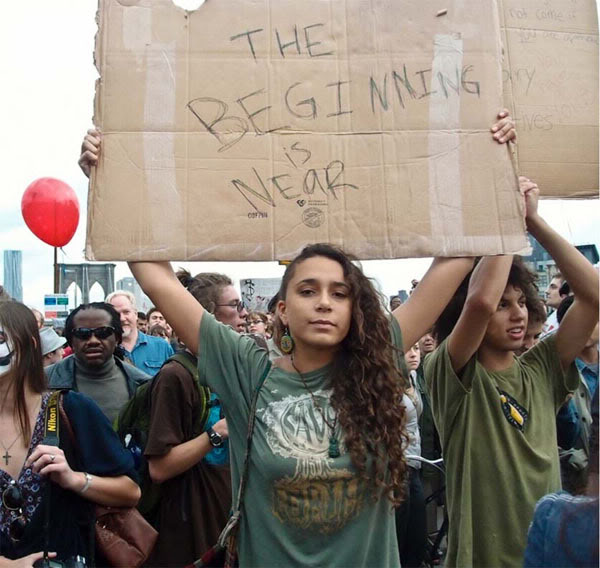
Economics shapes the bulk of our waking hours, so how do we reclaim control of our lives from such a dismal science?
—
As my friend David Fleming once wrote, conventional economics ‘puts the grim into reality’.
Something of a radical, back in the 1970s Fleming was involved in the early days of what is now the Green Party of England and Wales. Frustrated by the mainstream’s limited engagement with ecological thinking, he urged his peers to learn the language and concepts of economics in order to confound the arguments of their opponents.
By the time I met Fleming in 2006, he had practised what he preached and earned himself a PhD in Economics. But he never lost his aversion for the ‘economism’ that presumes that matters of public policy, employment, ecology and culture can be interpreted mainly in terms of mathematical abstractions.
Worse, he noted that even the word ‘economics’ has the power to make these life-defining topics seem impenetrable, none-of-our-business and, of all things, boring. Fleming’s work was all about returning them to their rightful owners—those whose lives are shaped by them: all of us.
Fleming was a key influence on the birth of the New Economics Foundation and Transition Towns movement, but it was only in the aftermath of his sudden death in 2010 that I discovered the breadth of the powerfully-different vision of economics that underpinned his life. On his home computer I discovered a manuscript for the book he had been preparing to publish after thirty years’ work entitled Lean Logic: A Dictionary for the Future and How to Survive It.
Reminding us that our present growth-based market economy has only been around for a couple of hundred years (and is already hitting the buffers), Fleming’s lifework looks to the great majority of human history for insight: “We know what we need to do,” he writes, “We need to build the sequel, to draw on inspiration which has lain dormant, like the seed beneath the snow.”
What he found was that—in the absence of a perpetually-growing economy—community and culture are key. He quotes, for example, the historian Juliet Schor’s view of working life in the Middle Ages:
“The medieval calendar was filled with holidays …These were spent both in sober churchgoing and in feasting, drinking and merrymaking
…All told, holiday leisure time in medieval England took up probably about one third of the year. And the English were apparently working harder than their neighbors.
The ancien régime in France is reported to have guaranteed fifty-two Sundays, ninety rest days, and thirty-eight holidays. In Spain, travelers noted that holidays totaled five months per year.”
Reading this took me back to a childhood fed by TV programmes like the BBC’s Tomorrow’s World, which had informed me that by now robots would be doing all the menial work, leaving humans free to relax and enjoy an abundance of leisure time.
So it came as a shock to realise that the good folk of the Middle Ages were enjoying far more of it than we are in our technologically-advanced society. What gives? Fleming explains,
“In a competitive market economy a large amount of roughly-equally-shared leisure time—say, a three-day working week, or less—is hard to sustain, because any individuals who decide to instead work a full week can produce for a lower price (by working longer hours than the competition they can produce a greater quantity of goods and services, and thus earn the same wage by selling each one more cheaply).
These more competitive people would then be fully employed, and would put the more leisurely out of business completely.
This is what puts the grim into reality.”
So in an economy like ours, a technological advance that doubles the amount of useful work a person can do in a day becomes a problem rather than a benefit. It tends to put half the workers out of work, turning them into a potential drain on the state.
Of course, in theory all the workers could just work half-time and still produce all that is needed, much as Tomorrow’s World predicted. But in practice they are often afraid of having their pay cut, or losing their jobs to a stranger who is willing to work longer hours, so they can’t take the steps needed to solve their collective economic problems and enjoy more leisurely lives. Instead, people are kept busy partly through what anthropologist David Graeber memorably characterised as “bullshit jobs.”
How, then, can we feed, house and support ourselves without working as relentlessly as we do today? Fleming’s work explores the answer, making a rigorous case that we need to get beyond mainstream economists’ ideas of minimising ‘spare labour’ if we are to sustain a post-growth economy. This ‘spare labour’ is what most of us would call spare time—a welcome part of a life well lived rather than a ‘problem of unemployment.’
He highlights that the holidays of former times were far from a product of laziness. Rather they were, in an important sense, what men and women lived for. ‘Spare time’ spent in feasting, performing, collaborating and merrymaking together formed the basis of community bonding and membership. Those shared cultural ties hold people together, even in the absence of economic growth and full-time employment. When productivity improves, as one of his readers put it, “in our system you have a problem, in Fleming’s system you have a party.”
Under the current economic paradigm, the only way to keep unemployment from rising to the point where the population can’t be supported is through endless economic growth, which thus becomes an obligation. So we are damned if we grow and damned if we don’t, since endless growth will eventually cross every conceivable biophysical boundary and destroy the planet’s ability to support us. That’s why, in practice, we just keep growing and cross our fingers that somehow it will all work out. As Fleming writes:
“The reduction of a society and culture to dependence on mathematical abstraction has infantilised a grown-up civilisation and is well on the way to destroying it.
Civilisations self-destruct anyway, but it is reasonable to ask whether they have done so before with such enthusiasm, in obedience to such an acutely absurd superstition, while claiming with such insistence that they were beyond being seduced by the irrational promises of religion.”
Technological fixes do not help, as we are all discovering to our cost. We are already working ever harder, and with ever more advanced technologies, yet the hope of a better future dwindles day-by-day. Take heart though, for when the current paradigm transparently provides nothing but a dead end, we can be sure that we are on the cusp of a fundamental shift.
Fleming provides a radical but historically-proven alternative: focusing neither on the growth or de-growth of the market economy, but the huge expansion of the ‘informal’ or non-monetary economy—the ‘core economy’ that allows our society to exist, even today. This is the economy of what we love: of the things we naturally do when not otherwise compelled, of music, play, family, volunteering, activism, friendship and home.
At present, this core non-monetary economy is much weakened, pushed out and wounded by the invasion of the market. Fleming’s work demonstrates that nurturing it back to health is not just some quaint and obsolete sharing longing but an absolute practical priority.
The key challenge of today, for Fleming, is to repair the atrophied social structures on which most human cultures have been built; to rediscover how to rely on each other rather than on money alone. Then life after the painful yet inevitable end to the growth of the monetary economy will start to seem feasible again, and our technological progress can bring us the fruits it always promised.
Lean Logic finally reached posthumous publication with Chelsea Green Publishing in September 2016, alongside a paperback version I edited out from it called Surviving the Future: Culture, Carnival and Capital in the Aftermath of the Market Economy.Needless to say, both books are deeply controversial, overthrowing as they do the central paradigm of our economy. As the writer Jonathon Porritt said at a launch event for the books last month, “there is no conventional political party anywhere in the world that doesn’t have economic growth as the underpinning foundation, but David Fleming developed unique, astonishing ideas about resilience and good lives for people without growth.”
It’s increasingly clear that this is the conversation we all need to have, and Fleming’s compelling, grounded vision of a post-growth world is rare in its ability to inspire optimism in the creativity and intelligence of human beings to nurse our economy, ecology and culture back to health. I am proud to have played a part in bringing it to the world; in fact, it might just be the best thing I have done.
Beyond Carbon Pricing
Originally published in the Carbon Management peer-reviewed journal on 16th April 2015
The formal version of record can be found here

This is the Abstract, Executive Summary and Introduction of the paper. Full text available here.
—
Reconciling scientific reality with realpolitik: moving beyond carbon pricing to TEQs – an integrated, economy-wide emissions cap
Abstract
This article considers why price-based frameworks may be inherently unsuitable for delivering unprecedented global emissions reductions while retaining the necessary public and political support, and argues that it is time to instead draw on quantity-based mechanisms such as TEQs (Tradable Energy Quotas).
TEQs is a climate policy framework combining a hard cap on emissions with the use of market mechanisms to distribute quotas beneath that cap.
The significant international research into TEQs is summarised, including a 2008 UK government feasibility study, which concluded that the scheme was “ahead of its time”. TEQs would cover all sectors within a national economy, including households, and findings suggest it could act as a catalyst for the socio-technical transitions required to maximise wellbeing under a tightening cap, while generating national common purpose towards innovative energy demand reductions.
Finally, there are reflections on the role that the carbon management community can play in further developing TEQs and reducing the rift between what climate science calls for and what politics is delivering.
Executive Summary
Framing
- Politics is not reflecting the urgency of climatology findings.
- Interdisciplinary analysis shows that carbon pricing is an unsuitable policy framework to guide the unprecedented emissions trajectory required.
Carbon pricing cannot deliver four essential features of an effective climate policy framework:
- Ensuring real and radical emissions reductions in practice.
- Facilitating public/political acceptability for the implementation of such cuts.
- Embedding a longer-term perspective into societal decision-making.
- Integrating cross-sector engagement with intrinsic motivation and society wide co-operation.
An alternative policy framework: TEQs (Tradable Energy Quotas)
- TEQs is similar to a national electronic rationing scheme for energy, but with legally tradable allowances. It could meet the four criteria outlined above.
- It combines downstream engagement with upstream enforcement and would cover all sectors of a national economy, including households.
- It would act as an umbrella framework, ensuring a hard cap on emissions and supporting other climate policy.
- Research into the scheme suggests that it may be expected to meet with greater public acceptability than carbon pricing frameworks, as it is a progressive scheme that would safeguard entitlements to energy while leaving households to manage their consumption as they see fit.
- TEQs draws on principles from social psychology in engaging a nation’s ingenuity in reducing energy demand. It attempts to define new norms of acceptable carbon consumption and create a clear shared goal, generating common purpose around intrinsic shared desires to overcome climate change and retain secure access to essential energy services.
A political history of TEQs
- TEQs was first developed in 1996.
- A UK government feasibility study in 2008 declared it “ahead of its time” on grounds of cost and public acceptability, and so the government withdrew from funding further research at that time, although expressing continued interest.
- Substantial research since, including 2011’s high profile cross-party parliamentary report, has challenged these negative conclusions.
Conclusion
- As members of the carbon management community, we must frankly recognise the shortcomings of carbon pricing frameworks.
- Hard cap based schemes are called for, and TEQs is the best-placed to reconcile the rift between science and politics.
- Governments must be challenged on their failure to implement their own carbon targets, and why they do not implement frameworks suited to do so.
- The carbon management community has a key role to play in refining, promoting and driving the implementation of TEQs in a national context.
The paper
Introduction
The essential problem is easily stated: there is a rift in realism. Realism about the findings of climate science demands dramatic and immediate emissions reductions if we are to avoid catastrophic destabilisation of the global climate [1,2]. Anderson and Bows argue that these reductions must be in the region of 10% per annum in industrialised (UNFCCC Annex 1) countries [3,201]. Yet present political reality in these countries says that such reductions are unthinkable [4]. While realists about climatology rightly argue that physical reality ‘bats last’ and does not negotiate, realists within politics argue with equal validity that any approach that tries to radically transform society against society’s wishes will be resented and, soon enough, rejected.
The failure to reconcile these viewpoints is perhaps the greatest obstacle facing the field of carbon management, since without clear agreement about where society is transitioning to, it becomes virtually impossible to effectively enable the sociotechnical changes required, and to retain the necessary public backing. If we are seeking only to tweak the economy for marginal, politically palatable emissions reductions, then carbon pricing might be an appropriate framework. For example, it can serve to stimulate the incremental adoption of ‘low hanging fruit’ such as overdue efficiency improvements [5]. However, climatologists are ever clearer that we require dramatic and unprecedented emissions reductions in order to avoid the worst ravages of climate destabilisation [6].
As Intergovernmental Panel on Climate Change lead author Josep G. Canadell recently stated in this journal, “The time has come to truly build carbon management into the deepest inner workings of society” [7]. Canadell goes on to state the common assumption that “no doubt” this should be achieved through carbon pricing. His recognition of the need for a coherent, overarching framework to harness the many facets of climate policy and action towards the goal of dramatic global emissions reductions is entirely justified. However, in this article we raise significant doubts that carbon pricing is the most appropriate candidate to deliver the speed and depth of change required, regardless of whether prices are set via carbon trading (e.g. the European Union Emissions Trading Scheme) or carbon taxation. The dominance of the argument that price-based mechanisms are best able to deliver change in an efficient and cost-effective way [8,9] may be concealing other options from view, but alternatives are both available and much needed.
As is widely recognised in the field of socio-technical transition, in order to achieve deep societal change, the path-dependency and political and cultural lock-in which underpins current carbon usage must be addressed. This requires careful consideration of the multiple levels where change can be directed, and where pressure can be brought to bear [10], in order to nurture individual and organisational agency and develop alternative practices [11,12]. Smith et al. and others within the field note that marginal approaches that “treat regime transformation as monolithic and dominated by rational action” [11] may have been appropriate for addressing problems such as acid rain or water pollution, but are unlikely to succeed when applied to more challenging problems like climate change and resource depletion, which require a range of fundamental, complex and interrelated system changes [11,13]. A fresh approach is therefore needed.
As such, we, the carbon management community, have contributed to the widening rift between science and politics by attempting to respond to the imperatives of climatology with policy interventions that do not reflect the workings of society. As the literature on socio-technical transitions shows, a reconciliation will require action from us all: scientists, policy makers, campaigners and the public [11,12,13,14]. Within academia, we can begin by improving our cross-disciplinary communication, in particular by aligning the latest climate science more closely with findings in the fields of socio-technical transitions, social psychology and climate policy, and vice versa. One of the aims of this Perspectives article is to contribute to this process.
We begin by arguing for certain necessary features that any successful carbon management framework needs to display if it is to enable the scale and depth of changes required, both technically and socially. We consider several ways in which current policy frameworks fail to meet these, and then go on to assess an alternative with significant political and research history – TEQs (Tradable Energy Quotas) – and whether it demonstrates the required features. Finally, we draw conclusions about appropriate pathways for future climate policy.
Music and Movement
Originally published as the editorial of the Fall/Winter 2014 edition of the Kosmos journal
The online version of the editorial can be found here

If you want to go fast, go alone. If you want to go far, go together. And if you want to transform…?
Sometimes we meet a young person who continues to hold a deep place in our minds and hearts long afterwards. I met Shaun briefly at the New Story Summit. It felt as though I had known him forever. The future of humanity and the hope of the world is with such talented and dedicated youth. I want to honor his work by sharing one of his essays.
~ Nancy Roof, editor, Kosmos journal
—
Like all the best tales, ours opens with music, and with Mark Kidel’s Resurgence article Conversation and Crossroads:
Some of the most powerful – and healing – forms of music combine strict ‘ways’ of doing things with free expression and the possibilities of interpretation or improvisation…
Wisdom and experience have suggested, in every corner of the world, that excessive self-expression is self-defeating and just as destructive as an over-zealous observance of rules and regulations. There is a need for a middle way which balances ‘hot’ and ‘cool’: the release of deep emotion with the articulacy and sophistication of formal aesthetic structures…
Whereas the enjoyment of pleasure was never frowned upon in the African context, it was set within a deeply rooted sense of ethical and aesthetic ‘right behaviour’ (as well as a strongly hierarchical community structure which held potential excess in check, and understood, in a highly sophisticated way, the need to balance creative self-expression with collective interaction and mutual support).
In the African and African-American context, the dancer who goes into trance is always being controlled in some sense by a divinity or spirits, so there is an element of ritual theatre which contains the fragility of the individual ego.
Similarly, at celebrations, no dancer hogs the floor for longer than a minute or two, reaching a brief climax, but not prolonging the transcendent thrill of near-ecstatic movement and expression beyond what is in some way ‘safe’ or acceptable in terms of strictly personal as opposed to collective expression.
Upon reading this I was powerfully struck by the concept of a community holding an artist safe while he or she explores the wilder reaches of individual expression. As Kidel goes on to argue, the absence of this protective tradition around Western rock music can be seen in the likes of Jimi Hendrix and Jim Morrison, who in the context of a culture entranced by individualism, found their lives overwhelmed and consumed by the awesome powers unrestrained artistic expression can unleash.
But these ideas have a far wider application. Rock music has merely reflected western philosophy and culture in its deification of the individual. When existentialism announced that ‘existence precedes essence’ – that we simply exist, and that any meaning we might then attribute to this ‘blank slate’ existence is solely created by ourselves and our own choices – we assumed that the ‘we’ in question must be our individual selves.
Our culture has moved further and further away from any sense of the collective, let alone concepts like oneness with Nature, or with all of creation, or even (Science forbid) God.

And it is this philosophy of ‘individualist existentialism’ – deeply embedded in our culture – that leads to the pervasive story that while some might find their meaning and fulfillment in trying to assure the future of endangered species, or disadvantaged humans, or even life itself, others may find theirs in greed, gluttony and destructiveness. For the true believer, there is no contradiction here because there is no underlying meaning to seek – only individual constructs.
Within the tenets of Western philosophy it appears a logically unassailable position given that everything is fundamentally meaningless and the freedom of the individual is simply self-evident, what possible reason could there be to cease doing whatever I may fancy?
There seem to me to be two key answers to this question. The first is consequences. What I fancy now may not produce what I fancy tomorrow. If I choose to attach meaning or desirability to a reliable electricity supply, or food supply, then there are certain things I should really pay attention to.
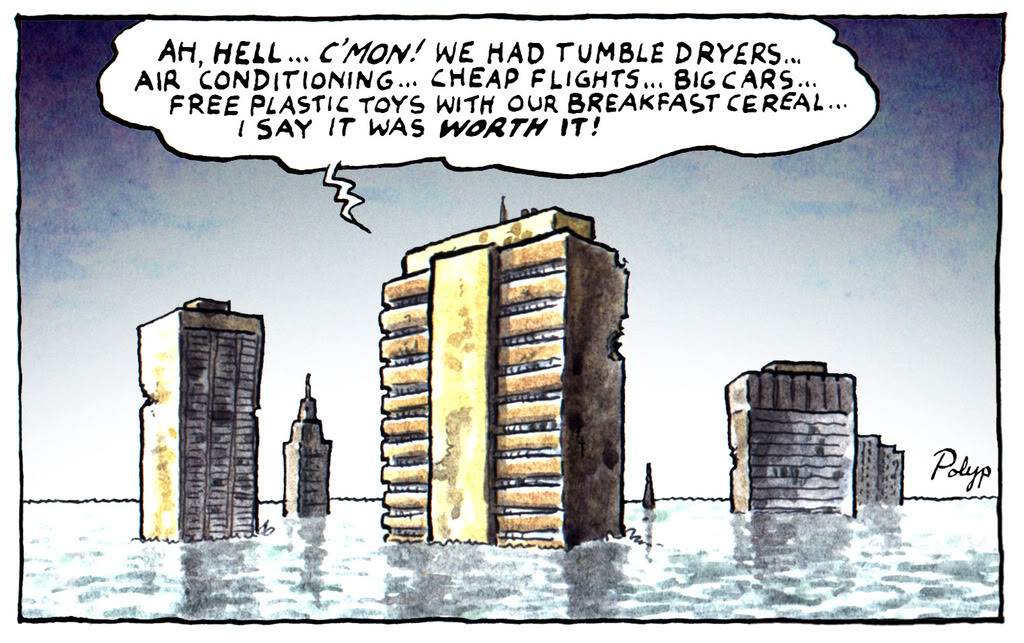
But the second is empathy. While we may feel less empathy with beings more different or distant from ourselves, few of us would claim to feel no empathy at all. There is perhaps a sliding scale from total individualism to the sense of oneness with everything that is described in many of the Eastern mystical traditions, as well as among earlier representatives of the Abrahamic religions like Christianity. It is no coincidence that we tend to find individualists despoiling our common environment and those at the holistic end of the scale defending it.
Existentialist individualism argues that one’s position on this scale is a fundamentally meaningless personal decision. Our innate sense of empathy might whisper otherwise, but our scientific understanding of collective consequences like climate change forces us to recognise that even if individual freedom is our sole aim, we still have to change course, as the consequences of our actions will seriously curtail the future choices facing both ourselves and the rest of life on Earth.
Viewed from this perspective, climate change represents the death of passive individualism as a coherent philosophy.
So when Kidel speaks of the highly sophisticated understanding African cultures have of “the need to balance creative self-expression with collective interaction and mutual support”, he is not just talking about a better way to dance, he is speaking of the very cultural wisdom we need to build the future we deserve.
–
An extended version of this piece was first published on Dark Optimism in 2008, with this abridged version first appearing in The Future We Deserve in 2012.
The Ecological Land Co-operative
Originally published in the Winter 2012 issue of Permaculture magazine; that article can be found here
The below extended version republished in the Jan 2013 issue of Country Smallholding. Full illustrated feature (including comment pieces from others) available here. The magazine’s editorial also concerned itself with the topics raised
And the Spring 2015 issue of STIR magazine featured an updated version, taking a different slant, which can be found here
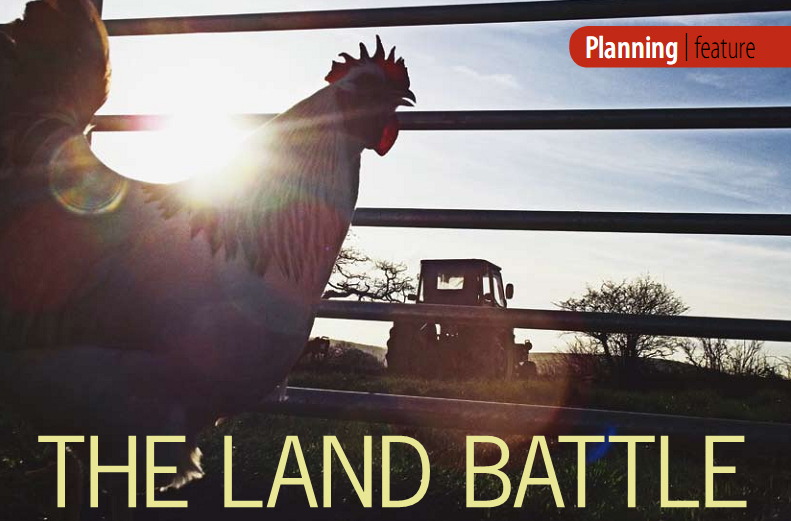
An imaginative and exciting scheme was launched to provide would-be smallholders with affordable land and low-impact dwellings. But then it was blocked by a local council, and has now gone to appeal. The story highlights how our planning process can frustrate so many ‘good life’ dreams. Shaun Chamberlin, who helped launch the scheme, explains
—
Nearly half of the UK’s land is owned by just 40,000 people (0.06% of the population).1 For those Country Smallholding readers only too familiar with the difficulties in securing affordable access to land, this will not be a comforting statistic.
Such land ownership ‘by the few’ tends to favour uniform, large-scale, mechanised agriculture, yet with the UK population having swelled by 4 million over the past decade, it becomes ever more pertinent that such farms have long been known to produce far less food per acre than smaller holdings (let’s not even mention the relative productivity of grouse moors or golf courses!).2
This may seem counter-intuitive – we all know that many smaller farms have been forced out of business due to being economically uncompetitive – but in fact it is not a lack of productivity that causes small farms to suffer in our modern economy.
Their first problem is that although they can produce substantially more food per acre, the big farms can produce more of a given monoculture crop per acre, which suits the large-scale centralised buyers (the supermarkets, who, incidentally, reportedly receive planning permission for a new UK store every working day of the year).
The greater challenge facing smallholders, however, is that their higher productivity per acre relies on higher employment. Just as the most productive parts of large farms famously tend to be the farmers’ gardens, where more time and attention is lavished on each plant among a diverse crop, smallholdings rely on careful human attention, which can be a major expense. Large-scale mechanised farms, on the other hand, have echoed other industries in taking advantage of fuel prices over recent decades to replace human care with cheap fossil energy, standardisation and monoculture. Yet with finite fossil fuel supplies depleting and oil prices having tripled over the past decade, the balance is shifting.
Smallholdings and horticulture, then, offer a crucial contribution towards higher employment, a reliable, home-grown food supply for the UK (rising energy prices are also a threat to cheap imports) and a diverse and thus more ecologically healthy countryside.
Considering this alongside our Government’s calls for more consumption of fresh fruit and vegetables and less dependence on state handouts, it is perhaps unsurprising to learn of the set up of a government-funded Land Settlement Association to provide over a thousand 5 acre smallholdings, and to train unemployed workers in the skills required to manage them.
Unfortunately though, this welcome initiative was launched in 1934, and was wound up – with all the holdings privatised – in 1983, by which point the LSA was producing around 40% of English home grown salad crops. The subsidies (and research funding) in place today are far more supportive of big agribusiness than of any modern equivalent of the LSA, but it nevertheless provides a practical example of what could be done.3
Back in the 1930s the primary motivation for supporting smallholdings in this way was to provide jobs for the unemployed, but the need for similar provision is perhaps more acute than ever today in the face of our profound environmental crisis. Industrialised agriculture is a major contributor to climate destabilisation, soil depletion and numerous other problems, while smallholdings provide an ideal context for diverse, low-carbon, localised lifestyles that could provide a desperately needed model for true sustainability.
Meanwhile, UK agriculture is suffering from a lack of new blood – the average age of a UK farm holder is now 58 – since private farms are now generally far too large for would-be new farmers to afford, and the ‘County Farms’ made available to new entrants by local authorities (around 40% of which are under 50 acres in size) are gradually being sold off as the austerity funding cuts bite ever harder.
Fair to say, then, that productive smallholdings could represent a key response to many of our most pressing social, economic and ecological problems. And, as the popularity of Country Smallholding attests, there is also a great appetite for the lifestyle they provide. Yet extortionate land prices and the intricate absurdities of the planning permission system combine to make the simple aim of living on and working a piece of land seem an unattainable dream for most of us.
What is to be done?
This collective plight led to energetic discussions in the spring of 2005 between members of Chapter 7, the ecological planning consultancy; Radical Routes, a secondary co-operative of co-operatives working for social change; Somerset Co-operative Services, a co-op development body; and farms and eco-communities like Landmatters, Lammas, Highbury Farm and Five Penny Farm.
We were yearning for a vibrant, living countryside in which humans flourish alongside our cherished landscapes and natural biodiversity, with small land-based enterprises providing meaningful employment while allowing residents to be rooted in rural communities and play a crucial role in ensuring food and energy sovereignty. We were longing for a proliferation of happy rural lifestyles, helping to maintain traditional skills and improve ecological literacy while providing access to local, sustainable crafts and food, as well as educational opportunities for urban visitors.
And, as so often when such breathy, passionate desires are unleashed, a child was eventually born – the Ecological Land Co-operative, a project created to provide affordable opportunities for new viable, ecologically beneficial projects to find land.
The basic idea of the Co-operative is that it buys land that has been, or is at risk of being, intensively managed, then uses its expertise and experience to oversee the process of securing planning permission for low-impact residences on site. Once this is achieved, the land is made available at an affordable price to people that have the skills to manage it ecologically but who could not otherwise afford to do so. The money received when the new residents buy their land is then used to purchase another intensively managed site, where the same process can begin, allowing more land to be ‘rescued’ from industrialised agriculture.
Prospective residents of a piece of land are only asked to buy in once planning permission for their homes is secured, but they do have to sign up to a strict management plan which requires that the land is always managed so as to maintain and enhance habitats, species diversity and landscape quality, and to facilitate the provision of low-impact livelihoods. There are also conditions stipulating that if they ever want to sell up and move on, the land must be sold on at an affordable price, so that the land is never priced out of reach. Beyond that, the land will be theirs to run as they see fit.
That was the idea. How about the reality?
Well, as an informal group, we received some early funding from the Co-operative Group in the South West for scoping and feasibility work, and at later stages in our development from the Co-operative Fund, Business Link and the Polden-Puckham Charitable Foundation. These helped us find our feet and put basic organisational structures in place.
In 2009 we sold community shares to finance the purchase of our first land, a 22-acre site on the Devon/Somerset border which we christened Greenham Reach. We have divided this land into three plots, in order to allow each of three ‘clustered’ smallholdings the independence to build their own dwelling and manage their land as they wish, while also enjoying the benefits of a small community for tool-sharing, sociability, mutual support etc. Accordingly, we also plan to provide some infrastructure to be shared between the three smallholdings – a timber barn with solar PV array and rainwater collection; improved access; a biological waste water treatment system and internal pathways linking the plots.
Unfortunately, shortly after our land purchase, the setbacks began, firstly in working with a planning agent who appears to have misled us and who failed to submit valid planning applications on our behalf on three separate occasions. This depressing episode set the project back by around a year, but we will definitely be wiser next time around.
Our original hopes to secure planning permission for the site before inviting applications from potential plotholders were also thwarted, as the District Council informed us that they wanted to see individual business plans from the prospective residents before they would consider granting permission. Accordingly, we advertised and went through a selection process last year, selecting from the applicants on a number of criteria including their farming and horticultural experience, vision and plans for the land, experience of low impact living and connection with the locality.
Together with our new intended plotholders, we then submitted the full applications for the three plots at the turn of the year, doing it ourselves this time. They ran to over 400 pages of careful documentation, and more than sixty letters of support were also received by the Council, including from experienced organic smallholders; local residents; the Soil Association; the Transition Network; Sustrans; Colin Tudge’s Campaign for Real Farming; Food Policy Professor Tim Lang and other academics; three MPs and even the Scottish Crofting Federation. A particularly heartening letter came from a planner of over 30 years’ experience, who described our work as “by some way the most carefully prepared applications for either an agricultural and/or low impact dwelling I have considered”.
Nonetheless, much like every other similar low-impact proposal, in June we attended a hearing to witness the rejection of our applications by the councillors on Mid Devon District Council’s planning committee. The vote for rejection (by a six to two majority, with three abstaining) was based on their vague statements that smallholdings are not “serious farming”, that the business plans (despite being carefully reviewed by a number of agricultural experts) “do not stack up” and that off-grid renewables are “not practical”. None of these are valid planning considerations, and we have good reasons to believe that we may win on appeal, as others have; not least because we are one of the few applications of this type to win the support of both the local Parish Council and the planning officers who spent the best part of a year carefully going through our applications. Going through the appeal process is of course more work and more delay, but it will all be worth it to ultimately see (quite literally) the fruits of our labours.
Small Is Successful
Our spirits have also been bolstered by grateful contact from others who have found it helpful to use and amend the documentation that we have produced for our applications (available on our website) in their own efforts to secure planning permission for land-based projects. We have also produced the Small is Successful report, which examined eight existing smallholdings with land-based businesses on ten acres or less. These documented examples demonstrate that economically viable and highly sustainable land based livelihoods can be created on such smallholdings, without the need for the subsidies on which large farms so often rely. The Research Council UK showcased Small is Successful as one of a hundred pieces of UK research “that will have a profound effect on our future”, and we have also presented our message at the House of Commons, to the All Party Parliamentary Group for Agroecology.
All in all, it has been a long struggle since those idealistic conversations seven years ago, but we believe that we are now closing in on the great satisfaction of having something simple and solid to show for our efforts – smallholders living on and working the land who would otherwise have been unable to do so. Appeal inspector permitting, we expect to reach this landmark early next year.
It will be a small beginning, perhaps, but we are already looking to apply the invaluable experience gained to date by finding further suitable land to make available in future. We dare to dream that it could be the start of a real solution to the thorny problem of land access here in the UK.
—
To find out more, take a look at our website: https://ecologicalland.coop/
Or follow us on Twitter: @EcoLandCoop
Any offers of time or assistance in our efforts also greatly appreciated.
1) Kevin Cahill, Who Owns Britain, Canongate, 2001.
2) See e.g. Peter Rossett (1999), “The Multiple Functions and Benefits of Small-Scale Agriculture“, The Institute for Food and Development Policy, 1999.
Gershon Feder (1985), “The Relationship between Farm Size and Farm Productivity“, Journal of Development Economics 18: 297-313.
Parviz Koohafkan, Miguel A. Altieri & Eric Holt Gimenez (2011), “Green Agriculture: foundations for biodiverse, resilient and productive agricultural systems“, International Journal of Agricultural Sustainability.
3) Dr. Peter Clarke, The Land Settlement Association: The return of the unemployed to the land 1934 – 1982.
Dark Optimism interview
Originally published in the June 2012 issue of Transition Free Press
A full online version of that issue can be read here. This interview appears on pages 8-9
In the first in our series of conversations with key thinkers and activists within the Transition movement, Charlotte Du Cann talks with Shaun Chamberlin about cultural stories, collaboration and the future.
—
In 2000 Shaun Chamberlin, a student of philosophy, received an email from his father out of the blue. By the way that future you were expecting is not going to happen. Here’s a link showing how the next decade is going to be all about resource wars and energy depletion. Just thought you ought to know, hope you are well…
It was, he said, his ‘peak oil moment’. The moment he started to immerse himself in what was then an obscure subject and that led him six years later to a course at Schumacher College called Life After Oil. Here he met the environmental and alternative economics thinker, David Fleming, whom he would work alongside until Fleming’s death in 2010. He also met Rob Hopkins, who soon commissioned him to write a report on the UK climate/energy crisis that became the book, The Transition Timeline.
“Many communities were finding it difficult to produce their local Energy Descent Action Plan (on which Transition is based),” he told me in a conversation we held on Skype, speaking from his home town of Kingston. “They knew about their local resources and skills, but needed help understanding the big scale things that were likely to affect them, such as climate change or UK food supply or national policy. How can we plan for our communities if we don’t know the context we are moving into? Without the bigger picture how can we know what we are grappling with?”
Three years ago most Transition initiatives were immersed in practical issues like alternative energy or awareness raising. The one change we had not anticipated was the way we would think and speak about the world:
“What ties everything together and makes meaning are our cultural stories. For the book I talked to hundreds of people and found that the dominant narratives of our future fell into three categories: business as usual (nothing really changes), doom of one kind of another (our time is up) and the myth of progress (we are the most advanced society ever known and our manifest destiny leads to some perfect Star Trek future).
“It’s easy to see why people are most drawn to this last story, Technotopia. The problem is the reality doesn’t bear it out. This Most Advanced Culture Ever has higher levels of depression and inequality than ever and is destroying the ecological systems that support everything that is alive on the planet, so it’s hard to justify the idea we are moving towards a better future.
“So we thought what we needed was another positive narrative about the future which is just as embedded as the other stories in our everyday culture, but one that reflects scientific evidence and the reality of what is happening in our world. A Transition vision. That’s what the book is about.”
Much of Shaun’s own story is set within this fourth narrative. As well as co-founding Transition Town Kingston (TTK), he has contributed chapters to several books, served as an advisor to the Department of Energy and Climate Change, co-authored the latest report from the All Party Parliamentary Group on Peak Oil and Gas, and helped both edit Mark Boyle’s upcoming The Moneyless Manifesto and bring David Fleming’s encyclopedic Lean Logic into print.
Fleming also invented a system known as Tradable Energy Quotas (TEQs), a rationing scheme that works to ensure energy for all in times of scarcity. Subtle and clever in its design, Shaun explained, but easy to use (much like an Oyster card).
“It would guarantee that we meet our emission reductions and most importantly support the active co-operation of all the energy users in a society in rapidly reducing their reliance on fossil fuels. David once said: large scale problems like climate change and peak oil do not require large scale solutions; they require small scale solutions within a large scale framework. Emissions ultimately come from people’s lifestyles, so you could have a perfect global agreement, but if no one actually acted on the local level, nothing would happen. What you need is a framework that stimulates and supports that local action in a fair way. TEQs provides that framework and sense of common purpose.”
I’m aware the conversation has shifted radically since I first met Shaun when he was the key speaker at an event organised by our local Transition group in Suffolk. We are now talking far more about the collective picture: the economic system, activist movements that work alongside Transition, like Occupy, and land rights co-operatives. But most of all about how this shift brings us all together as people:
“Robert Newman, the comic, once told me that the worst possible thing is feeling alone with the apocalypse. It causes you to doubt your sanity and slip into a doom mindset. As soon as you start actually doing something and facing reality, you realise you are not alone and there are people working world-wide for a better future.
“Transition doesn’t work in isolation. It’s part of an enormous movement that Paul Hawken once described as the earth’s immune system rising up to protect itself. What Transition does uniquely well within that is its outreach role, the way it can share that fourth, hopeful, narrative. It meets people where they are at and exposes them to ideas that maybe they haven’t come across before.
“One thing we need to challenge is the idealisation of financial independence in our culture. You are never truly independent, because your food and your services are still produced by someone, it’s just someone you don’t meet or care about. The Green Movement has its own version of this idealised independence, called self-sufficiency.
“What makes us happy though is interdependence, and the loneliness that pervades modern culture is in great part because people are ‘financially independent’. If they fall out with someone they can just pay someone else instead. It’s why community building often fails: we think if we go along every Tuesday at 7pm and do community it will create one. It doesn’t work like that.”
So our conversation centred on what interdependence might look like, what TTK has achieved in the last 5 years, but mostly about the future. “What is the ultimate time line?” I asked him. Shaun laughed. “I guess there a difference between what I see is the most likely scenario and the one I’m working for.
“As Hawken said, ‘If you look at the science about what is happening on earth and aren’t pessimistic, you don’t understand data. But if you meet the people who are working to restore this earth and the lives of the poor, and you aren’t optimistic, you haven’t got a pulse. What I see everywhere in the world are ordinary people willing to confront despair, power, and incalculable odds in order to restore some semblance of grace, justice, and beauty to this world.’
“I think that sums it up: scientifically speaking, it’s not pretty, but if you look at the response of that ‘immune system’ it is deeply inspiring. Spiritually speaking, I believe I chose on some level to come into history at this particular juncture, to be what I believe in, to try and make things better, and be the most loving, hopeful and inspiring I can be and ultimately none of the stuff that is going on in the world stops me doing that, so in that way it’s a wonderful time to be alive.”
That’s dark optimism for you.
–
Charlotte Du Cann is the Editor of Transition Free Press. A writer and community activist, involved with both Sustainable Bungay and Transition Norwich, she has also been the driving force behind the Transition Social Reporters Project.
Tradable Energy Quotas: A Policy Framework for Peak Oil and Climate Change
Originally published at The Oil Drum on Jan 24, 2011
Reaction and comments on the article can be found here

On the 18th January 2011, the UK’s All Party Parliamentary Group on Peak Oil (APPGOPO) launched their report into the TEQs (Tradable Energy Quotas) system of energy rationing.
Speakers included two Members of Parliament – John Hemming MP, Chair of APPGOPO and Caroline Lucas MP, author of the 2006 peak oil report Fuelling a Fuel Crisis. Also speaking were Jeremy Leggett, convenor of the UK Industry Taskforce on Peak Oil and Energy Security, and Shaun Chamberlin, co-author of the new report.
Copies of the report, answers to Frequently Asked Questions, video footage of the launch event and links to the media coverage can be found at: www.teqs.net

John Hemming MP, Chair of APPGOPO:
“I believe TEQs provide the fairest and most productive way to deal with the oil crisis and to simultaneously guarantee reductions in fossil fuel use to meet climate change targets”
(the UK Climate Change Act mandates 80% emissions cuts by 2050).
Political progress
APPGOPO’s endorsement of TEQs comes at an interesting time in the rationing system’s progress towards political acceptability. The inventor of TEQs, Dr. David Fleming (who passed away in November 2010), was a close friend of ASPO’s Colin Campbell and one of the early whistleblowers on peak oil, and designed TEQs explicitly to address peak oil as well as climate change. He first published on the system in 1996, but its profile has grown in tandem with that of the challenges it was designed to address.
TEQs first received a Ten Minute Rule Bill reading at Parliament in 2004, before extensive interest from research centres led to a Government-funded scoping study in 2006. This reached positive conclusions, and was followed by expressions of interest from successive Secretaries of State for the Environment.
Accordingly, the Government commissioned a pre-feasibility study into the system, which concluded in May 2008. The headline finding of this was that TEQs “has potential to engage individuals in taking action to combat climate change, but is essentially ahead of its time and expected costs for implementation are high… The Government remains interested in the concept and, although it will not be continuing its research programme at this stage, it will monitor the wealth of research focusing on this area and may introduce (TEQs) if the value of savings and cost implications change”.
The new APPGOPO report pulls together an impressive range of research to demonstrate conclusively that this condition has now been met, with bodies such as the Institute for Public Policy Research, the Lean Economy Connection, the Centre for Sustainable Energy and the UK Parliament’s own Environmental Audit Committee all having criticised the pre-feasibility study’s methodology and the decision to delay further moves towards implementation. One of the key criticisms is that the pre-feasibility study’s cost-benefit analysis was overly focused on carbon emissions, and entirely failed to take into account the benefits of ensuring fair access to energy.
More detail on the political progress to date is in Chapter 6 of the report, and links to the various reports and articles examining TEQs have been collected on the TEQs website here, including details of the world’s first tradable carbon rationing system in a ‘closed system’ island environment, being run by Australia’s Southern Cross University and starting in 2011.

Caroline Lucas MP, Leader of the Green Party of England and Wales, and author of Fuelling a Food Crisis:
“The TEQs system would guarantee that the UK’s targeted carbon reductions are actually achieved, while ensuring fair shares of available energy”.
How TEQs would work
So how does TEQs work, and how does it deal with the challenges that all rationing systems face?
TEQs is an energy rationing system designed to cover a nation’s whole economy, within which individual adults would receive an equal per capita Entitlement of electronic TEQs units, free-of-charge. Organisations, the government and all other energy users would have to buy their units at a Tender, or auction. The number of units issued into the economy via the weekly Entitlement and Tender would be determined by either the availability of energy resources or the national carbon budget – whichever represents the tighter constraint on the national economy at any given time.
The weekly auction would also generate a price for TEQs units, and all buying and selling of units within the nation would take place at that price (which would, of course, fluctuate in line with demand).
The purchase of any fuel or electricity within the national economy would require the surrender of TEQs units, alongside the usual monetary payment. Each TEQs unit would allow for the purchase of a set quantity of fuel or electricity. If the system were being used to address energy resource shortages, this quantity would simply be a proportion of the total resource available. If used to implement a carbon budget, it would be dependent on the lifecycle emissions associated with that energy source.
The TEQs design is based on the insight that all emissions from energy use within a national economy can be measured simply and efficiently by assigning a ‘carbon rating’ (e.g. 0.2 units per kWh, or 2.3 units per litre) to fuels and electricity, based on the quantity of carbon dioxide and other greenhouse gases generated by their production and use. Once this is established, the total emissions attributable to a given purchase becomes implicit in the quantities listed as usual on invoices, utility bills and till receipts.
The TEQs system simply uses this information, making it unnecessary to measure carbon emissions directly, or to grapple with the endless costs, complexities and compromises of embodied emissions calculations and carbon labelling. This ‘carbon rating’ for fuels and energy also provides a competitive advantage to retailers of more efficiently or renewably generated energy, who would not have to require their customers to surrender so many units.
The purchase of goods other than energy would not require the surrender of TEQs units, since the producers of those goods would have already surrendered units for the energy used in the production of the goods. Producers would then pass on the cost of buying these units to consumers, who would simply find that certain goods (those produced in a more energy-intensive manner) cost more.
Lord Smith of Finsbury, Chairman of the UK Environment Agency:
“Rationing is the fairest and most effective way of meeting Britain’s legally binding targets for cutting greenhouse gas emissions”.
Rationing? Really?
Rationing has acquired a bad name with the public due to its obvious association with shortage, yet it is clearly a response to shortage, not the cause of it. It might be argued that the word rationing contains two intertwined meanings. The first is limits to what people are allowed to consume, the second is guaranteed minimum shares for all. The first of these can cause resentment, but in times of shortage populations cry out for the second.
TEQs are rationing in the second sense as they guarantee an Entitlement to minimum shares for all, but they are not rationing in the first sense as they allow individuals to exceed their basic Entitlement (if they are willing to pay those who choose not to for the privilege). The purpose of TEQs is not to limit the consumption of individuals per se, but rather to share out fairly the shrinking energy budget required by national circumstances, and to allow maximum freedom of choice within that.
In the absence of such a framework, resources in short supply would simply go to the richest (“rationing by price”), strongest or quickest, creating massive inequity and attendant resentment. With TEQs everyone is guaranteed a basic Entitlement.
The reasons for making TEQs units tradable are twofold. Firstly, prohibiting the exchange of rations in the past has always led to substantial black market activity, unnecessarily criminalising otherwise law-abiding individuals. Secondly, energy demand differs from food demand (the most commonly quoted example of rationing, at least here in the UK); while we all require comparable amounts of food, certain vocations intrinsically require more energy. For this reason a non-tradable equal Entitlement would simply destroy many professions.
With tradable rations those who live within their TEQs Entitlement can sell their surplus onto the market, rewarding their energy-thrift and increasing the supply for those who want or need to purchase additional units. Since the poor use less energy than the rich, the system would also be redistributive.
The actual use of TEQs units would be very straightforward. As units are only required for direct purchases of energy, utility bills and fuel purchases are likely to be most people’s main direct engagement with the system. Utility bills are already easily paid by direct debit, and the TEQs cost of fuel purchases could either be paid together with the cash cost via a credit card linked to an individual’s TEQs account, or a separate TEQs card could be carried and swiped alongside the money transaction. If an individual had no card and needed to buy additional TEQs units the cost of these (at the current national price) would simply be added to their bill at the point of energy purchase.

Jeremy Leggett, convenor of the UK Industry Taskforce on Peak Oil and Energy Security:
“What I like about TEQs is the fairness of it.
When the energy crunch hits us, it will behove government and industry to ensure equitable access to available energy, within a national budget. TEQs is a route to synergisitic efforts of the kind we will need if we are to mobilise the infrastructure of a zero-carbon future
fast, under pressure.
It would increase the chances of working our way through the grim times to renaissance-through-resilience.”
Popular engagement
TEQs would have a price-balancing effect that would benefit the planning of energy consumers. The price of energy and the price of TEQs units will tend to move in opposite directions. When oil prices increase, this will reduce the demand for oil (at least to some degree), therefore reducing the demand for units and thus their price, so that the net price paid by consumers (oil + units) is more stable than the price of either oil or units alone.
Since the system covers the entire national economy, the variations in the national price of TEQs units would be of interest to all. And since lower demand means lower prices the population would be encouraged not only to reduce their own energy use, but also to work with other individuals and organisations and urge them to do so. Additionally, the substantial income from the weekly auction of units to organisations would be accessible to communities to fund the building of new local infrastructure or otherwise support their energy transition.
It would be transparently in the collective interest to work together in finding ingenious ways to increase low-carbon energy supplies, reduce demand and move towards the shared goal of living happily within our energy and emissions constraints, with the TEQs price providing a clear indicator of how well the nation is doing.
This cooperation is essential, since the rapid transformation in infrastructures necessitated by peak oil and climate change requires collaboration between the different sectors of society, united in a single system easily understood by all. It is a critical feature of TEQs that it encourages constructive interaction between households, businesses, local authorities, transport providers, national government, and so on. In short, the system is explicitly designed to stimulate common purpose in a nation.
The public may often be tempted to hold fossil-fuel companies and governments responsible for all our ills, but it must be recognised that even if these bodies wished to, they could not solve our energy problems without the engagement of the wider public. Our individual and community lifestyles need transformation too, and this cannot be done for us.
Jonathon Porritt, Founder Director, Forum for the Future:
“This eloquently presented proposal merits very serious consideration by all political parties.
There remains an undeniable gap between the current policy mix and what we actually need to do urgently both to reduce emissions of greenhouse gases and to avoid the potentially devastating consequences of declining fossil fuels.
Tradable Energy Quotas offer significant policy advantages in addressing both those pressing imperatives”.
Policy advantages
As is widely recognised, we currently have a contradiction at the heart of our energy/climate policy, with proposals for emissions caps to deal with climate change sitting alongside support for coal, tar sands and the like to address our energy challenges. It is increasingly clear that the common solution is to reduce fossil fuel usage, but the key approach to this thus far has been to focus on raising the carbon price.
Unsurprisingly, it has been hard to gain popular support for increasing the cost of fossil fuels, since people rightly perceive that this increases their cost of living. And this approach also leads us towards the self-contradictory pursuit of trying to raise the carbon price while striving to keep energy prices low.
TEQs offer a fundamentally different approach. Rather than raising the price of carbon/energy and hoping that this reduces demand sufficiently, TEQs start from a strict quantity-based budget, and allow price to find its level in response to that. This restores straightforward motivation for individuals, organisations and nations. Once you guarantee people a fair Entitlement, in line with a declining cap, society can then collectively focus its attention on finding ways to thrive on reduced demand, and thus keep the price of energy/carbon as low as possible. This is a simply-understood task that everyone can buy into with enthusiasm.
TEQs might also make a difference to negotiations at the international level, where agreements are proving so elusive. Introducing national TEQs systems would allow leaders to have confidence that the national emissions reductions they are discussing will actually happen, emboldening them to throw down the powerful challenge: “we are acting, so must you”.
* * *
More detail on every aspect of TEQs and its fit with existing UK and European policies and the energy and climate challenges it is designed to address can be found in the APPGOPO report, with Chapter 2 focused entirely on TEQs’ role in assuring entitlements to energy.
Obituary for David Fleming
Originally published in The Ecologist on the 21st December 2010
The online version of the article can be found here
Dr. David Fleming, a visionary Green thinker and one of the key whistleblowers on peak oil, has died aged 70. He was a significant figure in the genesis of the UK Green Party, the New Economics Foundation and the Transition Towns movement. His legacy also includes TEQs (Tradable Energy Quotas), the energy rationing scheme currently under consideration by the UK Government, his influential book Lean Logic and the real delight and inspiration he gave so freely to all who met him.
David was born on the 2nd January 1940 at Chiddingfold, Surrey, to Norman Bell Beatie Fleming, a Harley Street eye surgeon, and Joan Margaret Fleming, an award-winning crime writer.
After reading History at Trinity College, Oxford from 1959 to 1963, he went on to work in manufacturing, marketing and financial PR before earning an MBA from Cranfield University in 1968.
Despite being an avowed Conservative voter, he was a significant figure in the development of the UK Ecology/Green Party — his flat in Hampstead serving as its party office in the late 70s and early 80s — and urged his contemporaries to learn the language and concepts of economics in order to confound the arguments of their opponents. He practiced what he preached, and in 1979 began studies in economics at Birkbeck College, University of London, completing an MSc in 1983 and his PhD in 1988.
But Fleming’s true passion and genius was for exploring and understanding that mysterious thing ‘community’, in all its disparate forms. He admired tradition and ceremony for their ability to engender cultural stability, and was a lifelong member of deep-rooted groups as diverse as the English Folk Dance and Song Society, his local church in Hampstead, the Oxford and Cambridge Club, and ancient guild The Worshipful Company of Fishmongers. He was a passionate advocate for the critical importance of pubs, and memorably, when once asked how best to improve the resilience of one’s local community, he answered “join the choir”.
Always something of an intellectual whirlwind, Fleming found time to be Honorary Treasurer and then Chairman of the Soil Association between 1984 and 1991; to help organise ‘The Other Economic Summit‘ (TOES); and to edit the 1997 book The Countryside in 2097 before making a major contribution to the world’s awakening to peak oil.
“The next oil shock?“, Fleming’s April 1999 article for Prospect magazine, argued that the International Energy Agency (IEA)’s most recent report represented a coded message, warning of an impending energy crunch with potentially profound impacts. After publication, to Fleming’s surprise, Fatih Birol — the future Chief Economist of the IEA — suggested a meeting, at which Birol intimated that “you are right… there are maybe six people in the world who understand this”. This encounter gave greater impetus to Fleming’s drive to see an effective energy rationing scheme put in place. Having first published on his TEQs scheme in 1996, 2008 saw a UK Government funded pre-feasibility study into the idea, which will be followed by the All Party Parliamentary Group on Peak Oil’s report in January 2011.
Yet perhaps Fleming’s key focus over recent years has been the preparation of his magnum opus, Lean Logic: A Dictionary for the Future and How to Survive It, the work that pulls the various strands of his thinking together into one cohesive vision. As those who knew him recall with sighs and smiles, his perfectionism had led to numerous delays in the publication date, but Fleming was making final preparations for publication before his death. It will now be published posthumously, thanks to the determination of the many readers Fleming asked to comment on early drafts, many of whom claim it as a key influence on their work and thought. A good example is Transition Towns movement founder Rob Hopkins, who once humbly described his own work as “simply taking Heinberg’s insights into peak oil, Holmgren on permaculture and Fleming on community resilience, rolling them together and making the whole thing comprehensible”.
Indeed, so many of the seeds Fleming planted will continue to bear fruit long after his untimely passing. In his wry way, he would often describe himself as having failed at everything he turned his hand to, but the truth was anything but. As a young Transitioner put it, remembering his first meeting with Fleming, “I was left thinking that this was the sort of man I would aspire to be”.
Fleming was a sparkling conversationalist, an often hilarious writer and a remarkably attentive listener. Compassionate and encouraging, almost all who met him were utterly charmed. The vast wealth of reading and knowledge he could call upon, and the unusual connections he drew in the course of any conversation (or helter-skelter lecture) led him to produce content fit for weeks of dissection, if sometimes too rich for immediate absorption. Fortunately, Lean Logic should preserve his thought in a format well suited to lengthy contemplation.
Fleming is survived by his sister Penelope, his niece Lucy, nephew Ben and his extended family.
Dr. David Fleming (2 January 1940 – 28 November 2010)
More on Fleming’s work at: www.flemingpolicycentre.org.uk
The All Party Parliamentary Group on Peak Oil launch their report into TEQs on January 18th 2011.
My more personal tribute to David, and links to the other tributes paid online, can be found here.
Applied Philosophy
Originally published in the March/April 2010 issue of Resurgence magazine
The online version of the article can be found here

Don’t ask what the world needs. Ask what makes you come alive, and go do it.
—
For me, there was a definite moment when my environmental awakening began in earnest. I was studying philosophy at the University of York a decade ago when, out of the blue, I received an email from my father alerting me that “a long-term survey of oil and gas resources shows that demand for oil will exceed the maximum possible supply by 2010 and the oil price will sky-rocket”. This was followed by his (enduringly plausible) outline of the likely consequences – economic collapse, mass starvation and war.
I took a deep breath.
My initial reaction, like that of so many in their ‘peak oil moment’, was one of shock, rapidly followed by disbelief. I wondered how there could be near-universal silence on this issue if it truly had such vast implications, and tried to assure myself that ‘they’ would surely find some solution. Nonetheless, I resolved to look into it, partly in the hope of reassuring my father. Needless to say, what I learned wasn’t particularly reassuring.
As my studies came to an end, I quickly found myself with some appropriately philosophical questions to answer. The familiar post-university concerns of finding a way to earn some money, enjoying myself and caring for friends and family had to be balanced with two added factors – a sense that a ‘sound career path’ might not prove so sound in a civilisation that might be heading for the buffers, and an understanding that the world desperately needed all hands on deck if it was to have a future at all.
My attempts to discuss all this with my peers met with limited success. They reminded me that many people, both in our culture and around the world, are struggling to get by, and that I would need all the time I had just to look after myself and my family. Some suggested that I should be wary of having my life derailed by all this environmentalist rubbish, which had predicted ‘the end of the world’ so often before.
Others argued sadly that we must accept that it is simply human nature to go on being short-sighted and environmentally destructive. But that just sounded like a self-fulfilling prophecy. The many inspiring historical examples of human selflessness, wisdom and foresight must, if nothing else, show that we have a choice in these matters. Indeed, it seemed to me that those of us fortunate enough to have the time, education and mental health to perceive and face the circumstances of our world have a responsibility to act. If many others cannot, that is all the more reason why we must.
As Paul Hawken has since put it, maybe those of us responding to these challenges may be considered part of the world’s immune system. And where would any of us be if our own immune system got distracted seeking its personal fortune, say, or pursuing hedonistic diversions?
But while this musing was all very fine sitting in my university common room, how could I apply it to my life? My degree had failed to provide a helpful module on such ‘Applied Philosophy’ so, like everyone else, I had to make it up as I went along.
Time for another deep breath.
I did find one useful touchstone, a quote from the American theologian Howard Thurman:“Don’t ask what the world needs. Ask what makes you come alive, and go do it. Because what the world needs is people who have come alive.”
Wonderful stuff, but to ‘come alive’ I also needed to stay alive, so when a job offer came on the very day my bank account hit empty, I decided to take it, working as an administrator at a project for marginalised groups where I had previously volunteered.
Over the next few years I worked my way up to a position I loved – managing the project’s learning centre – paid off my student debts, and spent much of my spare time learning more about the state of our world. Unfortunately, these investigations led to a growing sense that ultimately there wasn’t much point in helping people to reintegrate with society if that society itself really was running off a cliff. I realised this job was no longer helping me to come alive. I felt called to something else, but what?
I didn’t know, but I left the job anyway, and spent my time reading everything I could get my hands on regarding peak oil and climate change, attending events and asking questions. Where could I best put my energies to create a peaceful, creative, resilient and diverse world?
I slowly came to see that those common room discussions about human nature were touching on just one of a wide set of cultural stories that shape and define our perception of the world. That, despite its severity and urgency, ‘Peak Climate’ is just a symptom, a product of the ways of thinking we value, respect and adopt. And that it is at this level that radical change is both necessary and assured. Of course, many have discussed the need for a rapid paradigm shift – the Age of Aquarius, the Great Turning – but I was still struggling to find my role in supporting and shaping it.
The resolution came when I found myself at Schumacher College in 2006, where I studied for a fortnight and felt more intensely alive than I had in a long time. This was surely a good sign, and here I had my first encounter with the fledgling Transition movement, which even at that early stage recognised the innate importance of stories and visions in building thriving, resilient communities.
Over the last few years I have become ever more involved with this work, and 2009 saw the publication of my first book, The Transition Timeline, which grew out of requests from Transition communities to flesh out what a realistic, positive vision for our future might look like, and for more input on the major challenges we are likely to face as we try to create it.
This allowed me to explore my fear that the Transition movement may struggle to match up to the scale of these challenges, and I found that the process shifted my own perspective. Whereas I probably started out trying to resolve all of the world’s problems single-handedly (and demanded the same of such initiatives), I have since noticed that the people and projects I respect most aren’t those who’ve tried to do everything, but those who have done the thing that they love rather brilliantly. In so doing they have, sometimes quite by accident, contributed to shifting the stories on which cultures are built.
So now I see myself not only as part of a team in my local Transition Town, but as part of a global movement to which we all lend our passions. Transition may not single-handedly ‘save the world’, but those who are trying to do so are certainly glad of its contribution, which seems a decent test of whether it is a worthwhile project.
As my book has made its way into the world, I have found myself invited to speak and write for local groups, parliaments and everything in between, and it is good to feel that I am contributing. Yet somewhere in my soul I can feel my next move gestating. At some important level, I feel called again to re-examine my role in the world.
It is time for another deep breath.
Transition Timeline interview
Originally published in the Summer 2009 issue of Clean Slate – The Practical Journal of Sustainable Living
A PDF of the full illustrated article can be found here
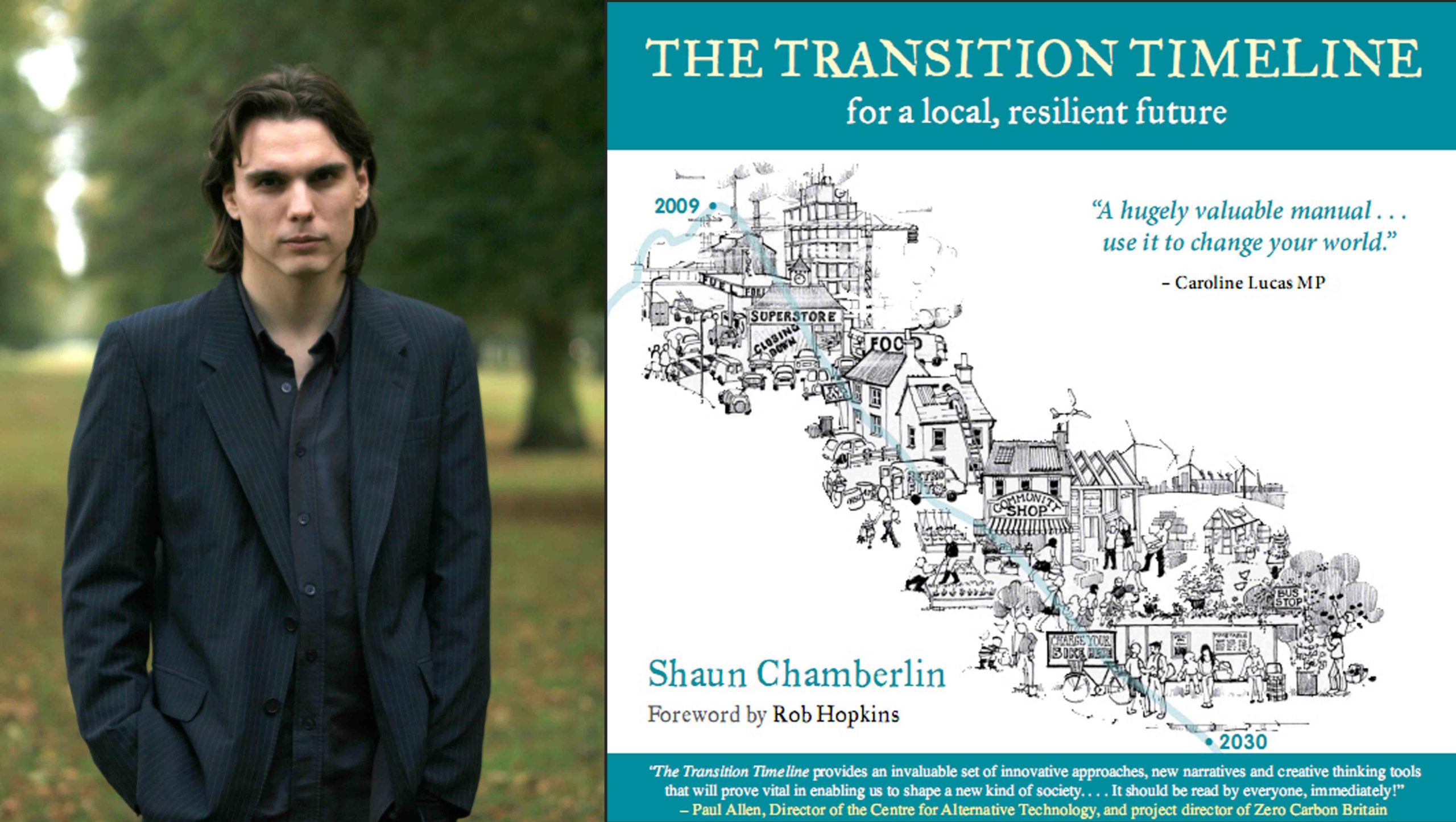
Blanche Cameron: What caused this book, The Transition Timeline, to come about?
Shaun Chamberlin: Primarily that Transition communities were asking for support. They were trying to form positive visions of the future for their communities, but were finding it a little foggy looking twenty years ahead, particularly with regard to the bigger trends and policy decisions around climate change, peak oil, food supply and the like. There was also a need to really make Transition’s vision of a resilient, satisfying future as tangible and fleshed out as possible.
BC: You talk in the book about four stories of the future: Denial, Hitting the Wall, The Impossible Dream and The Transition Vision. Where do we find those narratives in the UK at the moment?
SC: A good example of ‘Denial’ would be most government planning documents. Apocalyptic ‘Hitting the Wall’ scenarios are seen in many films, such as the recent Age of Stupid, ‘The Impossible Dream’ might be Star Trek, with its unlimited technological fixes, and the Transition Vision…well, the closest existing analogy Rob Hopkins could come up with was Wallace and Gromit!
What we need is for this positive, realistic vision to find a central place in the popular mindset, to really get people out of bed in the morning. The Age of Stupid has done a great job of showing how bad things could become, but we also need to set out the desirable, practical alternatives. We want to see these ideas spreading into films, soap operas and throughout popular culture.
BC: And doing it through stories – theatre, film, soaps and the like – makes it easier for people to absorb sometimes than preaching at them.
SC: Yes, it’s the paradigm shift in our behaviour, which a character can play out for us first. It helps us visualise how we can do things differently.
We need to supplement the existing approaches of individual action and marches and protests asking government to do something, which can both actually be rather disheartening. This is where Transition comes in – getting together to act as a community, without asking permission, alleviates the sense of impotence in acting alone, and the fear of simply being ignored when asking for others to do something.
BC: Is The Transition Timeline a philosophical background to Rob Hopkins’ Transition Handbook?
SC: Well, it is at heart a very practical book, but I do feel that it is hard to do environmental work without some form of underpinning belief system to fall back on when confronting difficult realities, whatever that might be. So when it felt appropriate I do touch on those areas. So many people are feeling despair and burn-out, but in any situation there are always better and worse courses of action, and working together with our communities – acting on a human scale – has an amazing power in it. As Edmund Burke said, ‘nobody ever made a greater mistake than to do nothing because he could only do a little.’
There’s also that wonderful Chinese proverb: ‘If you don’t change direction, you are likely to end up where you’re headed’. The recent G20 meeting is a classic example of us not changing our direction, but rather pumping more and more money into our old ways to try to keep them alive. Many alternatives do exist, but fundamentally it seems that we need to get away from the idea that greater consumption automatically equals a better life. Although we are consuming vastly more energy and resources than ever before, we actually seem to be less happy. And we are destroying Nature’s ability to support us to boot. So given the choice between a happier life and a future or neither, I know which way I lean!
BC: So what’s next for Transition?
SC: Who knows? That is up to the huge numbers of people shaping its future, and that of our world. There are hundreds, maybe thousands, of Transition initiatives starting, and it is starting to become mainstream, which is both exciting and challenging – I was recently interviewed on Transition by Elle magazine! The future for The Transition Timeline is that we plan to put it up on Appropedia so that as many people as possible can get involved in revising and co-creating the vision of the future we want to build. There’s also a forum on the Transition website to discuss The Transition Timeline.
–
Blanche Cameron is a community green builder, lecturer at the Graduate School of the Environment at the Centre for Alternative Technology and a director and trustee of RESET, a charity working with communities and organisations to increase resilience to climate change.
Carbon Budget
Originally published in the March/April 2009 issue of Resurgence magazine
A PDF of the full illustrated article can be found here
Ensuring essential entitlements to energy for all whilst guaranteeing that the UK meets
its target of 80% emissions reduction by 2050.
In these times of climate emergency, peak oil, economic turmoil and biodiversity devastation we are told again and again that large-scale problems require large-scale solutions – that we must channel our efforts into bigger, better global agreements to address these challenges.
As a young man searching for my calling in life I was being led in this direction until I attended the ‘Life After Oil’ course at Schumacher College and heard David Fleming utter a sentence that brought me up short:
“Large scale problems do not require large-scale solutions
– they require small-scale solutions within a large-scale framework.”
At the time this was a radical new concept to me, but the more I considered it the more obvious it became, and the more it transformed my perspective. For example, I realised that while it is tempting to think of a tightening global cap on emissions as a solution in itself, such a cap is meaningless without on-the-ground solutions at the local and individual levels.
The true challenge lies not in the essential process of agreeing a cap, but in transforming our society so that it can thrive within this limit. If we fail in this, the pressure to loosen or abandon any cap will become irresistible – “enough talk of future generations, my children are hungry today”.
So now that the UK Government (and President Obama) have agreed to an 80% emissions reduction by 2050 the focus must shift to implementing national frameworks that can engage communities in the transition to a lower-carbon society. At present the UK Government has over a hundred policies that impact on emissions levels but has produced, in the words of the Parliamentary Environmental Audit Committee,
“a confusing framework that cannot be said to promote effective action on climate change.”
We need a clear, focused framework for reducing emissions in the kindest way possible, and this is what the TEQs (Tradable Energy Quotas) scheme – developed by Fleming over the past twelve years – provides.
TEQs is an energy rationing scheme designed to cover a nation’s whole economy, within which individuals would receive an equal per capita entitlement of electronic TEQs units, free-of-charge. Organisations, the government and all other energy users would have to buy their units at auction. Each TEQs unit allows the purchase of a set quantity of fuel or electricity, dependent on the lifecycle emissions associated with that energy source. This ‘carbon rating’ provides an incentive to purchase renewably generated energy, which requires fewer units.
The number of units issued in total is limited in line with the national carbon budget, which decreases over time. The system thus both assures essential entitlements of fuel and energy for everyone and, crucially, guarantees that the overall carbon cap is respected.
The purchase of goods other than energy (food, furniture etc) does not require the surrender of TEQs units since the producers of those goods have already surrendered units for the energy used in their production. Producers then pass on the cost of buying these units to consumers, who simply find that certain goods (those produced in a more carbon-intensive manner) cost more, giving these a competitive disadvantage. In this way, all emissions in the economy are covered by the TEQs scheme, since energy is necessary to doing any kind of work.
Rationing has acquired a bad name due to its association with shortage, yet it is a response to shortage, not the cause of it. Combining the necessary reductions in the use of high-carbon fuel with the depletion of global energy resources is sure to put increased pressure on energy supplies, and in times of scarcity we cry out for guaranteed fair shares. The purpose of TEQs is to share out fairly the shrinking energy/carbon budget, while allowing maximum freedom of choice over energy use. In the absence of such a framework we are currently seeing ‘rationing by price’ (i.e. the richest get whatever is in short supply), which creates massive inequity and attendant resentment.
The reasons for making TEQs units tradable are twofold. Firstly, prohibiting the exchange of rations in the past has always led to substantial black market activity, unnecessarily criminalising otherwise law-abiding individuals. Secondly, energy demand differs from food demand; while we all require comparable amounts of food, certain vocations intrinsically require more energy. For this reason a non-tradable equal entitlement would simply destroy many professions. With tradable rations those who live within their TEQs entitlement can sell their surplus onto the market, rewarding their energy-thrift and increasing the supply for those who need to purchase additional units. Since the poor use less energy than the rich, the scheme would also be redistributive.
The real beauty of the scheme though is that it provides the large-scale framework to encourage and empower those small-scale solutions. It effectively converts the national carbon budget into a personal energy budget for everyone, with the clear recognition that this budget will be decreasing year on year. The variations in the national price of TEQs units would be of interest to all, and since lower demand means lower prices the population would be encouraged not only to reduce their own energy use, but also to urge others to do so. Additionally, the substantial income from the auction of units to organisations would be accessible to communities to fund the building of new local infrastructure or otherwise support their energy transition.
It would be transparently in the collective interest to work together in finding ingenious ways to increase low-carbon energy supplies, reduce demand and move towards the shared goal of living happily within our energy and emissions constraints, with the TEQs price providing a clear indicator of how well we are doing.
This cooperation is essential, since the transformation in infrastructures necessitated by climate change requires collaboration between the different sectors of society, united in a single scheme easily understood by all. It is a critical feature of TEQs that it encourages constructive interaction between households, businesses, local authorities, transport providers, national government, and so on. In short, the scheme is explicitly designed to stimulate common purpose in a nation.
We may often be tempted to hold fossil-fuel companies and governments responsible for all our ills, but it must be recognised that even if they wished to they could not solve our energy problems without the engagement of the wider public. Our individual and community lifestyles need transformation too, and this cannot be done for us. No system can ever relieve us of our personal responsibility, and it is essential that we all recognise the need to change the way we live.
It is becoming ever clearer that current levels of consumption in the UK cannot truly be ‘greened’; they must be reduced. Done right, this reduction process could produce a better quality of life for all, but the process itself is inevitable. There are environmental limits, and respecting them is not optional.
TEQs provides the essential framework for this process, and once it is in place we can focus on the human-scale changes that could actually save our world, safe in the knowledge that our individual teardrops are no longer lost in an ocean of apathy, but are combining into an empowered – and sufficient – wave of change.
For more information on TEQs, visit www.teqs.net
Peak Coal — Coming Soon?
Originally published at The Oil Drum: Europe on Apr 05, 2007
Reaction and comments on the article can be found here

The general consensus view on coal supplies has long been that we have hundreds of years of the stuff left, and that oil and gas depletion are the pressing concerns. However, dissenting voices are emerging. Canadian geologist David Hughes recently claimed that “peak coal looks like it’s occurred in the Lower 48 (US states)“, and the consensus position on coal is also called into serious question by the Coal: Resources and Future Production report just released by the Energy Watch Group in Germany. I present a summary of its findings here.
Reserves
The report highlights that the “proved reserves at year end” published in the most recent BP Statistical Review of World Energy in June 2006 are stated as being for year end 2005, but are actually based on the latest World Energy Council (WEC) assessments, which contain data for the end of 2002.
So our best figures on this are actually over four years old. And our worst figures? Well, some haven’t been updated in 15 years (China) and some in up to 40 years (Vietnam, Afghanistan).
But really the key message in the global data lies in the rate at which reserves estimates have been revised downwards. As Peak Oilers well know, conventional wisdom has it that reserves will increase as more exploration takes place and prices rise. Yet, in truth, estimates for global coal resources have been consistently revised down, and by 55% over the past 25 years, from 10 trillion tons hce (hard coal equivalent) in 1980 to around 4.5 trillion tons hce in 2005. Certain countries (including Germany and the UK) have been revised down by over 90% in this period. The UK reported proved recoverable reserves of 45bn tons in WEC 1980, but these were continually revised downwards to reach only 0.22bn tons by the latest report. Cumulative UK production in this period amounted to only approx 1.8bn tons.
Even Poland, the biggest coal producer in the EU, reports reserves revised down by 50% over the last 10 years. Since production alone cannot explain such revisions, they are deemed likely to be due to improvements in data. The chief exceptions to this rule are India and Australia, both showing significant upward revisions, but as we have seen the global trend is firmly downward. Only South Africa shows continuously shrinking reserves roughly in line with cumulative production. Globally, the report concludes that data quality is very poor and that these downward revisions must be expected to continue.
China
So back to China, the world’s largest producer, with the fourth largest reported reserves globally. The 2006 Statistical Review of World Energy credits China with 55 years of remaining reserves at current production rates (depleting its reserves at almost 2% per annum). But as previously mentioned, the Statistical Review faithfully reproduces proved reserves figures which were last changed in 1992 (note that China’s cumulative production in the 15 years since comes to about 20% of those stated reserves), so we can knock 15 years off that number straight away, reducing the remaining total reserves to 40 years’ worth. The Energy Watch Group report gives projected production profiles showing that China is likely to experience peak coal production in the next 10-15 years, followed by a steep decline. It should also be noted that these production profiles do not take into account uncontrolled coal fires which — according to satellite based estimates — add around 5-10% to regular consumption. Since China’s production dwarfs that of any other country (being almost double that of the second largest producer, the USA) the global coal production peak will be heavily influenced by China’s production profile.
Types of Coal
Now, before I outline the situation in the USA, which comfortably holds the world’s largest reserves of coal, it may be instructive to distinguish the different types of coal. There are four basic types, starting with the most energy-rich — anthracite (about 30 MJ/kg), bituminous coal (18.8-29.3 MJ/kg), sub-bituminous coal (8.3-25 MJ/kg) and lignite (5.5-14.3 MJ/kg). Those towards the anthracite end of the scale are often termed ‘hard coal’, and those towards the lignite end of the scale as ‘soft coal’, although the exact definition of these terms varies. The softest coals are sometimes termed ‘brown coal’.
USA
The USA, then, as we have all heard, has reported proven coal reserves that would allow continued production at current rates for more than 200 years. Three federal states (Wyoming, Montana, Illinois) hold about 60% of US coal reserves, but the low production rates relative to reported reserves in Montana and Illinois cast some doubt on the reliability or suitability of those reported reserves. As many of these reserves are of low quality, with high sulphur content and/or other drawbacks, it may be considered doubtful that they will ever be produced. Measured in terms of produced tons per miner, US productivity steadily increased until 2000, but has declined since, which also implies that ‘easy coal’ is running short.
The USA had passed peak production of anthracite (by far the rarest form) by 1950 and peaked in bituminous coal in 1990, but sub-bituminous coal more than made up for this decline in terms of tonnage. However, the US has now switched from being a net exporter to a net importer of steam coal and the report argues that total (volumetric) US coal production will peak between 2020 and 2030. However, due to the lower energy content of softer coals, the total energy content of annual US coal production actually peaked in 1998.
Global Picture
So, having looked at the world’s biggest coal producer and the holder of the world’s biggest reserves, we may perhaps turn our attention to the global picture.
Six countries (USA, Russia, India, China, Australia, South Africa) hold about 85% of world coal reserves, when this is measured in terms of energy content. According to the latest assessment by the WEC, total world reserves at the end of 2002 stood at 479bn tons of anthracite and bituminous coal, 272bn tons of sub-bituminous coal and 158bn tons of lignite, although for countries without large reserves, it is worth noting that only 15% of coal produced globally is exported, the rest being consumed domestically. Australia alone is responsible for almost 40% of global coal exports.
According to the Energy Watch Group, global coal production can increase for 10-15 years (mainly driven by China), but then production of anthracite and bituminous coal will peak around 2020 at a production rate around 30% higher than at present. Lignite production is predicted to peak somewhere between 2050 and 2060. However, as the quality of coal produced will be declining continuously the world coal energy peak is projected to come around 2025. It is also important to note that ‘peak coal exports’ should come even earlier, as lower-energy-density coals are not worth transporting long distances.
When we compare this with the scenarios (represented by the dashed and the solid line) from the IEAs 2006 World Energy Outlook (WEO) we get the following graph (click to enlarge):
As we can see, according to this report the WEO reference scenario is unrealistic, and only the production in the WEO alternative policy scenario (which assumed political measures constraining coal due to fears over greenhouse gas emissions) is actually feasible. The Energy Watch Group’s report, however, is not considering potential policy constraints, and is describing only what production may be physically possible.
I must stress that one of the key findings of this report is that data quality is very poor globally, and so all of the findings should be taken with that caveat, but the trends do seem clear. Indeed, we sent a copy of this report to Richard Heinberg and he has revealed that a Dutch study-in-progress using different criteria has reached preliminary results confirming this report’s findings. And the poor data quality is itself hardly reassuring for an energy source which is becoming increasingly central to our global future.
This report clearly carries many serious implications, but for now I’ll just share the information and leave these to be discussed on TOD. Further analysis of the report has also recently been released in Heinberg’s March MuseLetter.
Selected published articles
Transforming Our Relationship *with* the Future
A Dictionary for Our Times
The Sequel: Life After Economic Growth
Confessions of a Hypocrite: Utopia in the Age of Ecocide
For Hallowe’en This Year, I’m Dressing as the Economy
Beyond Carbon Pricing – Carbon Management journal
Music and Movement
The Ecological Land Co-operative
Dark Optimism interview
A Policy Framework for Peak Oil and Climate Change
Obituary for David Fleming
Applied Philosophy
Transition Timeline interview
Carbon Budget: TEQs